History of Destination Weddings — Origins, Timeline & Global Evolution | Comprehensive Guide
Quick Summary: Destination weddings, where couples marry outside their hometowns — often in another country or scenic locale — began as the privilege of elites in the 18th–19th centuries. Today, they’ve grown into a global industry valued at around US$39.2 billion in 2024, projected to reach US$171.1 billion by 2033, fueled by rising incomes, social media influence, and the demand for unique, memorable experiences.
Introduction, Definition & Why the History of Destination Weddings Matters
Introduction
Weddings are among the oldest and most meaningful traditions across cultures — ceremonies that celebrate not only love, but also family, community, and identity. For centuries, they were local affairs: hosted in ancestral homes, neighborhood temples, village squares, or churches where families lived.
But history shows us that weddings are not static. They evolve with society, shaped by travel, culture, and aspiration. Out of this evolution came the destination wedding — a celebration that combines the intimate ritual of marriage with the grandeur of travel and exploration.
From aristocrats marrying in European capitals during the 18th century, to modern couples exchanging vows on Santorini cliffs or Caribbean beaches, destination weddings mirror how human societies redefine love, mobility, and belonging across time.
What Is a Destination Wedding?
At its simplest, a destination wedding is:
- A wedding celebrated away from the couple’s hometown or country of residence.
- It may be domestic (a different city/region within the same country) or international (crossing borders to another nation).
- It often blends the wedding with tourism, offering guests cultural experiences, leisure, and travel.
Modern destination weddings typically involve:
- A symbolic location (beach, palace, heritage site, vineyard, mountain resort).
- Travel and accommodation for the couple and guests.
- Multi-day events — from pre-wedding parties to post-wedding honeymoons.
In short: a destination wedding is not just a ceremony — it’s a curated travel experience, merging personal love stories with cultural backdrops and landscapes.
Why Does the History of Destination Weddings Matter?
The history of destination weddings is more than romance — it is a reflection of cultural, economic, and social change. Here’s why it matters:
- Cultural Shifts in Marriage
- In ancient and medieval societies, weddings were largely about family alliances, economics, or tradition.
- Over time, the focus shifted toward personal choice, romance, and individuality — a shift destination weddings embody perfectly.
- Evolution of Travel & Technology
- The rise of the European Grand Tour in the 18th century introduced the idea of marrying in distant, exotic locales.
- The invention of steamships, trains, and later airplanes made long-distance weddings possible for more than just the elite.
- Today, low-cost airlines and global hospitality networks make it feasible for middle-class couples worldwide.
- Economic & Tourism Impact
- Destination weddings have become one of the most lucrative sectors of wedding tourism.
- The industry was valued at US$39.2 billion in 2024 and is projected to reach US$171.1 billion by 2033 at a CAGR of 17.3%.
- Another study predicts it could hit US$135.8 billion by 2029, driven by social media and the experience economy.
- Cultural Exchange & Identity
- Couples increasingly seek to incorporate local customs — from Hawaiian chants to Balinese blessings — creating hybrid cultural experiences.
- For diaspora couples, such as Bangladeshis living abroad, destination weddings back home provide a bridge between heritage and modern global lifestyles.
- Sustainability & Future Choices
- As the industry expands, questions arise about its carbon footprint, inclusivity, and cultural sensitivity.
- Understanding history helps us plan sustainable, ethical, and culturally respectful destination weddings for the future.
Closing Thought: Love, Travel, and the Beginning of a Global Tradition
In essence, the history of destination weddings is the story of love meeting mobility. It shows how personal dreams have always intersected with global changes — evolving from aristocratic extravagance into a modern, mass-market aspiration.
With this foundation in mind, let’s step back in time to explore the earliest roots of weddings — from ancient and medieval societies, through the European “Grand Tour” era, and into the aristocratic unions of the 19th century — where the seeds of today’s destination wedding tradition were first planted.
The Origins and Evolution of Destination Weddings (18th–Early 20th Century)
Before “destination weddings” became an industry worth billions, they were woven into the fabric of history in far more intimate — and often dramatic — ways. From runaway carriages clattering toward Gretna Green, to aristocrats staging opulent ceremonies during the European Grand Tour, and from Bengal zamindars hosting riverborne festivities to American heiresses marrying into European nobility, weddings have always been shaped by travel. This era reveals how love, law, spectacle, and heritage first converged to make place and journey as important as the vows themselves.
Runaway Love & Legal Loopholes: Elopements in History
When we imagine “destination weddings,” we might picture cliffside vows in Santorini or beachfront ceremonies in the Maldives. But the earliest form of destination weddings wasn’t glamorous. It was dangerous, secretive, and often scandalous: the elopement.
In 1754, the English Parliament passed the Marriage Act, making it illegal for anyone under 21 to marry without parental consent. What was meant to enforce morality instead sparked a wave of rebellion. Young couples, desperate to be together, climbed into carriages in the dead of night and rode north, crossing the border into Scotland.
Their destination: Gretna Green, a tiny village just beyond England’s reach. Here, marriage laws were looser. Any two consenting adults could wed with little more than a declaration. Local blacksmiths, already symbols of fiery craft, became “anvil priests.” With each strike of the hammer, another union was sealed.
Imagine it: the icy wind, the pounding of horse hooves, the smell of iron and coal in the blacksmith’s shop, and the thrill of defying family, law, and convention. These weren’t glamorous weddings, but they were electric.
👉 Did you know? Gretna Green became so famous that it was referenced in novels, plays, and songs across Britain. Even today, it attracts over 5,000 couples a year, many drawn by its history of rebellious romance.
Elopement Era: Infographic Timeline of Runaway Weddings
- 1754 🏛️
The English Marriage Act sparks an elopement craze across Britain. Couples under 21 travel to Scotland to marry, making Gretna Green a famed wedding escape.
- Late 18th Century 💌
Gretna Green becomes the “wedding escape” capital, attracting runaway couples from across Britain due to Scotland’s permissive marriage laws.
- 1856 📜
The Marriage (Scotland) Act requires at least one party to have resided in Scotland for 21 days before marriage, slowing the flow of immediate elopements.
- Today 💑
Modern couples still flock to Gretna Green, keeping the spirit of elopement alive as a romantic, personalized alternative to large weddings.
Elopements transformed marriage: no longer just a community ritual, but a personal adventure. For the first time, love truly began to travel.
The Grand Tour: Weddings as Theatre
By the late 17th and 18th centuries, Europe’s elite weren’t hiding their weddings. They were staging them.
The Grand Tour had become the ultimate finishing school for young aristocrats. British nobles traveled across France, Italy, and Switzerland, studying art, architecture, and language. They attended masquerades in Venice, admired ruins in Rome, and commissioned portraits in Florence.
Naturally, weddings followed. Families staged marriages abroad, using architecture and scenery as a form of cultural display. A wedding in Rome wasn’t simply a union — it was theatre, a performance of wealth, sophistication, and education.
“A marriage in Rome is as noble as the Colosseum itself,” wrote one Grand Tourist in his diary.
These ceremonies blurred the line between travel and performance. They signaled that location itself could carry meaning — a lesson that destination weddings still reflect today.
Aristocrats, Heiresses & Headline Spectacles
The 19th century added a new layer: weddings as international news.
American industrial wealth collided with Europe’s struggling nobility, creating the phenomenon of the “Dollar Princesses.” These heiresses, daughters of railroad barons and steel magnates, married European aristocrats in palatial settings.
The most famous case was Consuelo Vanderbilt, who in 1895 married the Duke of Marlborough at Blenheim Palace. She was only 18, pressured by her mother into the union. “I spent the morning of my wedding in tears,” she later confessed.
Yet newspapers focused not on her unhappiness but on the jewels, gowns, and grandeur. Blenheim Palace — itself a World Heritage Site today — became a backdrop as important as the vows.
👉 Did you know? Between 1870 and 1910, more than 350 American heiresses married European nobles, turning transatlantic weddings into mergers of wealth and status.
These ceremonies were the original celebrity weddings: gossip-worthy, photographed, and imitated. Just as today’s weddings in Tuscany or the Maldives set Instagram trends, Vanderbilt’s wedding showed how location + spectacle = cultural influence.
Queen Victoria’s White Wedding: Fashion Goes Viral
Not all trends came from heiresses. In 1840, Queen Victoria married Prince Albert in a white gown — a bold choice, as most brides wore their finest colorful dress, often red or gold.
Her portraits, widely circulated in engravings and photographs, turned white into the global symbol of bridal purity. Within decades, white gowns became fashionable across Europe and colonies alike.
👉 Did you know? Victoria’s choice wasn’t just symbolic — it was political. She wore white to highlight handmade lace from Britain, boosting the national industry.
This wedding proves a timeless point: one high-profile wedding can reset global trends. In the 19th century, it was Victoria’s dress. Today, it might be Priyanka Chopra’s palace ceremony or George and Amal Clooney’s Venetian vows.
Beyond Europe: Global Traditions of Travel and Spectacle
While Europe gave us Gretna, the Grand Tour, and Dollar Princesses, the concept of marrying away from home is far older and more global.
- South Asia: Maharajas staged palace weddings that lasted weeks, with fireworks, feasts, and elephant processions. In Bengal, zamindar families traveled by decorated riverboats to ancestral estates for marriages that united villages and dynasties.
- Ottoman Istanbul: Royal weddings transformed the city into a theatre of music, parades, and feasting, drawing guests from across the empire.
- Japan & China: Imperial weddings required relocating entire courts. These weren’t just unions but political rituals affirming dynastic legitimacy.
- Africa: In Buganda and Zulu kingdoms, royal weddings drew clans from vast distances, showcasing travel as a unifier.
Why this matters: The roots of destination weddings are not Western inventions. Across cultures, weddings have always been occasions for travel, spectacle, and communal gathering.
Diaspora Weddings: Bangladesh as a Living Tradition
The story of destination weddings also lives today in diaspora communities. For Bangladeshis abroad, a wedding is often a homecoming.
British-Bangladeshi, Canadian-Bangladeshi, and American-Bangladeshi couples frequently return to Sylhet, where ancestral homes and tea estates become the stage for multi-day weddings. Others choose Cox’s Bazar, the world’s longest natural sea beach, for receptions that rival Caribbean resorts.
- Gaye Holud: turmeric paste glowing under canopies of marigolds, drums and songs echoing across courtyards.
- Nikah ceremonies: held in Dhaka’s historic mansions or restored heritage halls.
- Beach receptions: lanterns and fireworks illuminating the shoreline.
For these families, the wedding is more than romance — it is identity, heritage, and belonging.
👉 Did you know? Sylhet is often called the “wedding capital of the Bangladeshi diaspora”, as thousands of NRB ((Non-Resident Bangladeshi) couples travel back each year to marry on ancestral soil.
This mirrors centuries of tradition: just as Gretna lovers crossed borders or Vanderbilts sailed the Atlantic, diaspora couples travel home — proving that weddings remain journeys of the heart.
The Early 20th Century: Glamour and Mass Tourism
By the 1900s, travel technology changed the game. Steamships, railways, and luxury hotels expanded what was possible.
- The French Riviera, Monaco, Capri, and Switzerland became playgrounds for elite weddings.
- Hollywood stars held glamorous ceremonies abroad, with photographs fueling public fascination.
- Hotels began offering wedding packages, the earliest seeds of today’s wedding tourism industry.
For the first time, middle-class couples could aspire to marry away from home. Travel was cheaper, photography more accessible, and resorts actively courted wedding business.
The seeds of the modern destination wedding industry were firmly planted.
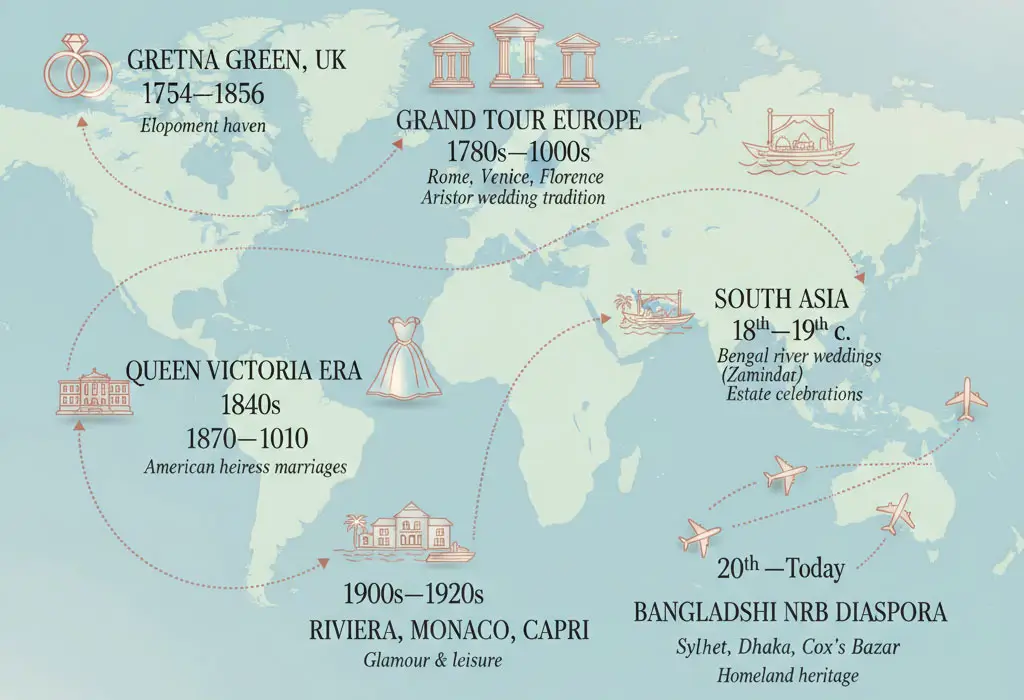
Global Milestones in Early Destination Wedding History
- Early Context (1754–1856) 🏴
Early elopements at Gretna Green inspired the concept of destination weddings in Europe, setting a precedent for international travel-based ceremonies.
- 1780s–1800s 🏛️
Aristocrats on the Grand Tour hold lavish weddings in Rome, Venice, and Florence, blending travel with social prestige.
- 1840 👑
Queen Victoria popularizes the white wedding gown, influencing bridal fashion worldwide.
- 1870–1910 💰
The “Dollar Princess” era sees 350+ wealthy American heiresses marry European nobles, merging American wealth with aristocratic prestige.
- 1895 🏰
Consuelo Vanderbilt weds at Blenheim Palace, generating international media attention and setting the standard for luxury weddings.
- 1900s–1920s 🏖️
The Riviera, Monaco, and Capri emerge as glamorous wedding destinations for elite travelers.
- South Asia (18th–19th c.) 🏞️
Zamindar weddings along Bengal’s rivers blend elaborate rituals, grand processions, and communal celebration, showcasing wealth and prestige.
- Bangladeshi Diaspora Traditions (20th c.–Today) ✈️
Bangladeshi NRBs return for heritage weddings in Sylhet, Dhaka, and Cox’s Bazar, blending traditional rituals with luxury, personalization, and modern wedding trends.
🌍 The Democratization and Modern Industry of Destination Weddings (20th Century to Today)
The 20th century marked a turning point in the history of weddings — a time when love stories began to travel as widely as the couples themselves. No longer limited to palaces or hidden chapels, ceremonies spilled onto ocean liners, sunlit beaches, and grand hotels. With the rise of trains, steamships, and airplanes, weddings shifted from private rituals to global spectacles. Resorts, professional planners, and celebrity culture further fueled this change, turning the once-exclusive privilege of aristocrats into a worldwide industry. What began as rare extravagance became a booming tradition that now blends tourism, culture, and romance on nearly every continent.
Weddings Take Flight: A New Chapter for Love
The story of destination weddings entered a new phase in the 20th century. What had once been the privilege of aristocrats and royals began to shift toward the middle class, the diaspora, and eventually millions of couples worldwide. The reason was simple yet powerful: mobility.
Trains, steamships, and, later, airplanes allowed couples to dream beyond their hometowns. Resorts, planners, and vendors turned those dreams into packages. Media and celebrity culture transformed them into aspirations. And by the time Instagram and TikTok arrived, destination weddings weren’t just a niche — they were a global industry.
✈️ The Age of Mobility: Steamships, Trains & Jets
Every wedding story needs movement — the carriage, the walk to the mandap, the bridal procession. In the 20th century, entire nations became part of the procession.
Steamships & Railways: Setting the Stage
At the dawn of the 1900s, the romance of travel itself was intoxicating. Railways connected London to Paris in a matter of hours. Steamships carried newlyweds across the Atlantic to New York, Havana, or Rio. The glamour of these journeys became part of the wedding story.
Imagine a wedding party boarding a train at Victoria Station, their trunks packed with gowns and gifts, heading to Venice for a lakeside celebration. Newspapers covered such journeys with fascination. Love was no longer only about who — it was about where.
Quick Fact about Travel’s Role in Destination Weddings
The Jet Age: When Love Took to the Skies
The real breakthrough came after World War II. The rise of the jetliner in the 1950s and 1960s made destinations that once took weeks to reach suddenly accessible in hours. Honeymoon ads often doubled as wedding invitations: “Fly Pan Am to Hawaii — Begin Your Life Together in Paradise.”
For the first time, middle-class couples could imagine marrying in Rome, Santorini, or Hawaii. The idea of “marriage as travel” spread rapidly.
Quick Fact about Airplanes and Weddings
Budget Airlines & Mass Travel
By the 1990s and early 2000s, low-cost airlines changed everything again. No longer was a European beach wedding reserved for elites. Couples from Manchester could fly to Ibiza, or from Delhi to Phuket, for less than the cost of a lavish hometown banquet.
The equation had flipped: sometimes it was cheaper to marry abroad with fewer guests than to host hundreds locally.
🏨 Resorts & Hotels: Turning Love Into a Package
The rise of air travel set the stage, but resorts and hotels wrote the playbook. They realized weddings weren’t just ceremonies; they were products.
The Birth of Wedding Packages
Luxury hotels in Europe and the Caribbean began offering bundled services:
- A seaside lawn for vows.
- Champagne and catering menus.
- Floral arrangements, music, and a photographer.
- Discounted guest rooms and group bookings.
This packaging transformed the process. Couples no longer had to stitch together logistics; they could book a full wedding with one contract.
Quick Fact about Resort Wedding Packages
All-Inclusive Resorts: Predictability Meets Romance
The rise of all-inclusives in places like Cancun, Jamaica, and the Maldives made weddings easier to budget. Guests enjoyed food, drinks, and entertainment in one price — a relief for families.
For resorts, weddings became big business. Some host hundreds of weddings a year, each designed to feel unique while running on efficient systems.
🌍 The Planners, Vendors & Ecosystems That Made It Work
If airplanes and resorts opened the door, planners and local vendors walked couples through it.
The Rise of Professional Planners
The late 20th century saw wedding planners evolve into destination specialists. They organized FAM (familiarization) trips, building trust with venues abroad. A bride in Chicago could hire a planner who had scouted resorts in Mexico, or a groom in Dhaka could rely on a cousin’s planner in Sylhet to handle guests flying in from London.
Local Vendor Clusters
Resorts couldn’t do it alone. Successful destinations nurtured ecosystems:
- Florists growing seasonal blooms.
- Bakers creating custom cakes.
- Musicians offering traditional or modern sets.
- Photographers skilled at destination lighting.
The economy benefitted too. In some Caribbean islands, wedding tourism became a crucial off-season revenue stream, sustaining florists, musicians, and decorators year-round.
📸 The Role of Media, Celebrity & Social Platforms
From Grace Kelly to Instagram Brides
Grace Kelly’s wedding to Prince Rainier in Monaco (1956) was beamed around the world. Elizabeth Taylor’s marriages, some abroad, made headlines. These spectacles planted the idea that a wedding’s location could be as important as the gown.
Magazines picked up the trend. Glossy spreads showed Caribbean beaches and Tuscan villas as backdrops. For middle-class couples, it was fantasy — but fantasy sells.
The Digital Explosion
Today, inspiration is instantaneous. Pinterest mood boards, Instagram reels, TikTok montages — couples scroll and dream. A single viral clip of a Santorini cliffside ceremony or a Maldives floating mandap can inspire thousands.
👉 Did you know? The hashtag #DestinationWedding has attracted hundreds of millions of views on TikTok, making it one of the fastest-growing wedding-related tags.
💰 The Business of Weddings: From Romance to Industry
By the late 20th century, destination weddings were no longer a curiosity — they were an economic force.
- Market estimates in 2024 place the industry between $30–40 billion, depending on scope.
- Projections suggest it could exceed $100 billion by the early 2030s.
- Growth is driven by rising incomes, global mobility, and social media visibility.
This isn’t just about couples — it’s about entire ecosystems: airlines, hotels, caterers, florists, tour guides, and local artisans.
Quick Fact about the Global Wedding Market
💌 Guests: Between Intimacy & Expense
Destination weddings often mean smaller guest lists but higher per-guest spending. A wedding of 70 in Tuscany can cost less than hosting 500 in Dhaka, Mumbai, or New York.
But guests carry the financial burden. Flights, hotels, visas, and time off work make attendance a challenge. This creates delicate etiquette questions.
Etiquette Tip: Experts suggest inviting guests at least 12 months in advance, offering group discounts, and providing virtual participation options.
🌱 New Forces: Pandemic, Sustainability & Personalization
COVID-19: Reinventing Rituals
The pandemic disrupted weddings worldwide, but it also created innovations:
- Micro-weddings: 20–30 guests.
- Hybrid weddings: livestreamed vows.
- Destination postponements: couples booked venues 2–3 years out, creating pent-up demand.
Sustainability & Ethics
A growing number of couples ask: how can we celebrate without harming the planet?
- Use local, seasonal flowers.
- Offset travel emissions.
- Support community-based vendors.
Destinations that adapt — offering eco-certifications or cultural authenticity — will thrive.
🇧🇩 Bangladesh: A Cultural Destination in Waiting
For the Bangladeshi diaspora, destination weddings often mean a return to roots.
Why Bangladesh Appeals
Bangladesh may not yet headline glossy global wedding magazines, but for couples — especially those with diaspora roots — it offers a tapestry of heritage, scenery, and celebration unmatched elsewhere. What makes it so magnetic?
- Sylhet — Weddings Rooted in Ancestry: For thousands of NRB (Non-Resident Bangladeshi) families, Sylhet is more than a region — it’s home. Weddings here often unfold in family estates or among rolling tea gardens, where heritage meets breathtaking scenery. A Sylheti wedding isn’t just a union; it’s a reunion with generations.
- Cox’s Bazar — The Ocean as Witness: With the world’s longest natural sea beach, Cox’s Bazar provides a cinematic backdrop — fiery sunsets, endless sands, and luxurious hotels rising to meet growing demand. It’s perfect for both large-scale celebrations and intimate seaside vows, often followed by seaside bonfires and starlit receptions.
- Dhaka’s Heritage Halls — Nostalgia with Grandeur: In the capital, restored zamindari mansions and colonial-era halls offer regal spaces filled with history. Chandeliers, marble staircases, and antique woodwork provide a timeless stage where modern couples can host ceremonies that feel like stepping into a bygone era.
- The Sundarbans & Eco Venues — Adventure Meets Romance: For couples seeking something extraordinary, eco-resorts near the Sundarbans or riverbank venues bring nature into the celebration. A wedding here isn’t just an event — it’s a once-in-a-lifetime experience with mangroves, rivers, and wildlife as part of the story.
- Cultural Richness & Multi-Day Traditions: From turmeric-golden gaye holuds to mehendi nights bursting with music, Bangladeshi weddings offer vibrant rituals that naturally stretch across several days. Each event allows creative staging: rooftop mehendis in Dhaka, riverside holuds in Barisal, or fusion receptions abroad.
- A Feast Like No Other: Cuisine is central to Bangladeshi weddings. Elaborate buffets featuring kacchi biryani, roast, rezala, and fusion menus draw guests as much as the décor. For NRBs, this food is nostalgia — a chance to give international guests a taste of heritage on a lavish scale.
- Affordability with Luxury: Compared to Western or Middle Eastern destinations, Bangladesh can offer high-end venues, catering, and décor at a fraction of the cost, allowing couples to host large celebrations without compromising on quality.
- Diaspora Connection & Emotional Pull: For many NRBs in the UK, US, and Middle East, hosting a wedding in Bangladesh is a chance to reunite far-flung relatives. It becomes more than a ceremony — it’s a global family gathering rooted in shared ancestry.
Quick Fact about NRB Weddings in Bangladesh
Practical Realities
- Winter and post-monsoon are peak wedding seasons.
- Infrastructure is improving, but large weddings need careful planning.
- Hotels in Cox’s Bazar book up fast — early reservations are essential.
Bangladesh may not yet be globally marketed as a wedding hub, but for NRBs, it is a homecoming wrapped in celebration.
🎯 The Playbook for the Future
Destination weddings today combine intimacy, storytelling, and experience. Couples want more than a ceremony; they want a journey.
- Smaller but richer: fewer guests, higher per-guest spend.
- Storytelling venues: locations that reflect heritage or romance.
- Hybrid-friendly: livestream for distant relatives.
- Eco-aware: green choices matter.
Destination Weddings by the Numbers
Trends, Drivers & Global Impact
- Social media buzz and viral wedding trends
- Strong diaspora connections bringing families home
- Rising incomes fueling premium experiences
- Celebrity and influencer culture shaping aspirations
- Affordable and accessible air travel
- Luxury resorts and unique venues
- Professional wedding planners and curated vendor ecosystems
- Lifetime memories and once-in-a-lifetime experiences
- Cultural exchange and heritage celebration
- Personalized celebrations reflecting each couple’s story
- Unique photo-worthy locations for unforgettable moments
- Boosts local economies and tourism
- Expands career and business opportunities in the wedding ecosystem
- High guest costs and logistics
- Complex paperwork and legal requirements
- Growing focus on sustainability and eco-friendly practices
Current Industry Valuation
$30–40BProjected Market Size (by 2030)
$100B+Destination weddings are no longer niche—they are a global phenomenon blending love, culture, luxury, and unforgettable experiences.
The Lasting Legacy of Destination Weddings: Love, Travel, and Timeless Memories
The 20th century showed us that weddings are no longer confined to homes or temples—they unfold wherever love, adventure, and imagination meet. From the elegance of Monte Carlo steamships to the breathtaking sunsets of Cox’s Bazar, modern destination weddings prove that marriage has always been both a vow and a journey, blending culture, luxury, and unforgettable experiences. Each celebration tells a story, leaving memories that travel far beyond the ceremony itself.
Beyond the Perfect Picture: What Really Happens at Destination Weddings
From Instagram reels, it looks effortless: a bride in silk, vows at sunset, champagne fizzing under fairy lights. But destination weddings are more than photos — they’re social experiments. They test families, friendships, budgets, and traditions in ways home weddings rarely do.
The beauty of these events isn’t only in the décor — it’s in the dramas, dilemmas, and delights that unfold when people travel for love.
Families on the Move: The Social Adventure
When weddings happen far from home, families live together in ways they never do at local banquets. Cousins who barely nod at each other in London suddenly share breakfast buffets in Sylhet for a week. Mothers-in-law who feared each other bond while bargaining with local sari vendors.
This forced proximity — planes, hotels, long dinners — is what makes destination weddings so transformative. They don’t just unite couples; they remake family relationships.
Quick Fact about Family Ties & Destination Weddings
The Emotional Layer: Intimacy, Exclusion, and FOMO (Fear of Missing Out)
Destination weddings often spark two opposite emotions: intimacy and exclusion.
- For those invited and able to attend, it feels like being in the couple’s inner circle — a privilege.
- For those who can’t, it can sting. Travel costs, visas, or work commitments leave some people behind.
This duality creates subtle politics. Many couples soften the edges with livestreams or by hosting smaller “at-home receptions” later. The point isn’t to exclude — it’s to make the main event possible.
Imagine this: A Bangladeshi-American couple marries in Cox’s Bazar. Only 100 can fly in, but 500 join a second dinner in New Jersey a month later. Two continents, one celebration — no one left behind.
Fashion and Food: How Culture Travels on Suitcases
Destination weddings are mobile catwalks. Guests carry their identities in luggage: saris folded beside tuxedos, lehengas stuffed between sneakers, cocktail gowns riding next to turbans.
- In Tuscany, Indian brides wear red lehengas against olive groves, blending two worlds.
- In Dhaka, diaspora brides in white gowns walk into zamindari halls, followed by cousins in tuxedos and cousins in sherwanis.
- In Bali, Bangladeshi grooms might mix a sherwani with local flower garlands.
And then, the food. Wedding cuisine is where nostalgia meets novelty:
- NRB couples in Sylhet serve kacchi biryani alongside Italian gelato.
- Caribbean weddings pair jerk chicken with Bengali fish curry for the diaspora family.
- A gaye holud in Cox’s Bazar may end with both traditional pithas and chocolate fondue.
Food becomes the ultimate bridge — every bite is a memory, a negotiation, a discovery.
The Bangladesh Diaspora Story: Weddings as Homecomings
For the Bangladeshi diaspora, destination weddings in the homeland aren’t exotic getaways — they’re emotional pilgrimages.
- Sylhet: Known as “Little England” for its migrant history, weddings here often see entire UK-based families fly back to ancestral estates. It’s less about luxury and more about reconnecting with heritage.
- Cox’s Bazar: Diaspora couples choose it for grandeur — a chance to wow foreign guests with sunsets over the Bay of Bengal.
- Dhaka: City weddings provide a mix of heritage and convenience — five-star hotels for guests, historic halls for photos.
Why this matters: For NRBs, marrying in Bangladesh isn’t just an event. It’s a narrative of identity: we belong both here and abroad.
👉 Quick Fact about NRB Weddings
In Sylhet, wedding season often fills entire tea estates with relatives flying in from the UK, Middle East, and North America.
When Cultures Collide: Fun, Awkward, and Memorable Moments
Destination weddings thrive on cultural mashups. Sometimes they’re elegant — sometimes hilariously awkward.
- A Bangladeshi groom in a sherwani dancing to a salsa band in Spain.
- A British best man mispronouncing Bengali names in his speech, making the crowd roar with laughter.
- A mehndi night in Italy where locals join the dance, learning Bollywood steps under fairy lights.
These moments — the unscripted, imperfect ones — are what guests remember long after the décor fades.
The Future: Meaning Over Magnitude
What’s clear from the modern arc of destination weddings is this: couples no longer measure success in numbers but in meaning.
- Smaller, deeper gatherings over giant banquets.
- Experiential extras: boat rides, guided tours, cooking classes for guests.
- Hybrid reach: livestreams for absent relatives.
- Eco-awareness: less waste, more purpose.
Imagine a Bangladeshi-British wedding where the nikah is held in Sylhet, the gaye holud on Cox’s Bazar’s sands, and the reception livestreamed to Toronto. One love, three continents, a thousand memories.
Destination Weddings in Bangladesh: More Than Just a Celebration
The hidden layers of destination weddings — family bonding, cultural fusion, food and fashion, diaspora identity — show us that these events are not just tourism products. They are living theaters of love and belonging.
And perhaps that’s why they matter: not because they are grander than local weddings, but because they bring people into new places, new cultures, and new versions of themselves.
The Future of Destination Weddings: Trends, Technology & Timeless Love
Destination weddings are evolving into something far more meaningful than a ceremony abroad. As couples embrace new trends, blend technology with tradition, and celebrate love across cultures, these weddings are becoming symbols of both modern sophistication and timeless romance. From virtual guest participation to sustainable choices and cultural fusions, the future of destination weddings reflects not just style—but also values, identity, and belonging. In Bangladesh and beyond, they’re no longer just about the perfect backdrop; they’re about creating experiences that connect families, honor heritage, and write unforgettable love stories.
Weddings Beyond Borders: Where We Are Now
The history of destination weddings has carried us from runaway carriages in the 18th century to jetliners, Instagram reels, and billion-dollar resort industries. Today, destination weddings aren’t a luxury for the few — they’re a living, breathing part of global culture.
But if history has taught us one thing, it’s this: weddings are always evolving. The future promises ceremonies that are smaller yet richer, global yet intimate, traditional yet reimagined.
💡 Trend 1: Micro-Luxury Over Mega-Banquets
In the past, weddings were measured in numbers — hundreds or thousands of guests, endless courses of food, giant venues. Now, couples often choose intimacy over scale.
- Smaller guest lists: 40–100 people, curated carefully.
- Higher per-guest spend: luxury experiences like wine tastings, boat cruises, or private concerts.
- Emotional value: time to connect with each guest instead of waving across a ballroom.
👉 Quick Fact about Micro-Weddings
Since 2020, micro-weddings and “elopement-style” destination ceremonies have grown rapidly, often focusing on immersive, luxury experiences for fewer guests.
📲 Trend 2: Hybrid & Tech-Infused Celebrations
The pandemic accelerated a shift toward hybrid weddings. This isn’t going away.
- Livestream ceremonies: grandparents in Toronto watch nikah vows in Sylhet in real time.
- Drone cinematography: aerial shots of beach ceremonies in Cox’s Bazar or vineyards in Tuscany.
- AI planning tools: guest RSVP tracking, seating chart generators, even mood board design.
🌱 Trend 3: Sustainability as Standard
Eco-consciousness is no longer a niche request — it’s an expectation.
- Carbon offsets: group flight offsets or tree-planting initiatives.
- Local sourcing: seasonal flowers, farm-to-table catering.
- Minimal waste: modular décor, reusable props, digital invites.
- Eco-venues: destinations promoting conservation, like Sundarbans eco-lodges or Costa Rican rainforests.
Quick Fact about Sustainable Weddings
🌏 Trend 4: New Destinations Rising
Classic hubs like Italy, Bali, and the Caribbean remain strong — but new locations are gaining attention.
- Bangladesh: For diaspora couples, Sylhet tea estates and Cox’s Bazar beaches combine heritage with spectacle.
- Georgia & Armenia: Wine-country weddings in historic monasteries.
- Vietnam & Cambodia: Affordable yet exotic backdrops with growing hospitality sectors.
- Eastern Europe: Castles in Serbia, lakes in Slovenia.
As air routes expand and social media showcases hidden gems, new “it” spots emerge every year.
🕊️ Trend 5: Cultural Blending & Fusion Rituals
The modern couple rarely sticks to one tradition. Instead, weddings have become cultural mosaics:
- A Bengali mehndi night followed by a Western white-dress ceremony.
- A Catholic blessing inside a Tuscan chapel with a Hindu pheras on the villa lawn.
- A Nikah in Dhaka, followed by a vineyard reception in Bordeaux.
Fusion is not only accepted — it’s celebrated. Each wedding becomes a personal story stitched from heritage, love, and creativity.
🎶 Imagine the Future: A Wedding in 2035
Picture this: A couple from London, with roots in Bangladesh and Kenya, decide to marry in Cox’s Bazar. Their closest 60 guests arrive via direct charter flight. Others join virtually through VR headsets, walking digitally through the decorated beach venue.
The vows are spoken in three languages. Guests dine on kacchi biryani alongside vegan fusion menus, with everything sourced locally. A carbon offset project plants 1,000 mangroves in the Sundarbans in the couple’s name.
The wedding film? Streamed live, edited instantly by AI, and delivered to phones before dessert is finished.
This isn’t fantasy. This is the direction weddings are heading: personal, immersive, global, and responsible.
Destination Weddings: Past vs. Future
How modern love and values are shaping global celebrations.
Past (20th Century)
- Mass Guest Lists: Weddings often included hundreds of relatives and acquaintances.
- Resorts as “Wedding Factories”: Standardized packages with little personalization.
- Print Magazines for Inspiration: Couples relied on bridal magazines for trends and décor ideas.
- Travel as Luxury: Destination weddings were mostly about prestige and exotic locations.
Future (21st Century)
- Smaller, Curated Guest Circles: Intimate weddings focused on meaningful connections.
- Sustainable Venues & Eco Choices: Green practices, local vendors, and minimal waste take center stage.
- Social Media & AI-Driven Inspiration: Pinterest, Instagram, and AI tools inspire unique, personalized weddings.
- Travel as Identity & Heritage Connection: Weddings become cultural journeys, connecting couples and families to traditions and experiences.
💡 Key Insight
Destination weddings have evolved from lavish, uniform events into personalized, sustainable, and culturally rich celebrations—a reflection of modern love, identity, and values.
Bangladesh’s Place in the Future
Bangladesh’s potential is tied not just to beaches or hotels, but to diaspora emotion. For NRBs, the homeland isn’t just a backdrop — it’s a stage where heritage is celebrated and shared with global friends.
If infrastructure and promotion align, Bangladesh could step onto the global map as a niche-but-powerful hub: a country where weddings mean both celebration and homecoming.
Final Reflection: The Journey of Love and Place
From runaway carriages to private jets, from aristocratic palaces to tea estates in Sylhet, the history of destination weddings is ultimately the history of love adapting to place. Each era reshaped weddings to fit its technologies, economies, and values.
Today’s couples stand at a new frontier — balancing beauty with responsibility, spectacle with intimacy, heritage with innovation. The future of destination weddings won’t just be about where people marry, but about how thoughtfully they celebrate.
Because at its heart, a destination wedding is more than a party in a faraway place. It’s a promise carried across borders, woven into landscapes, and shared with the world.
Destination Weddings for Foreign Nationals in Bangladesh
Bangladesh, with its lush landscapes, heritage sites, and vibrant culture, is increasingly capturing the attention of foreign couples seeking unique and memorable wedding experiences. These celebrations go beyond exotic backdrops—they are immersive journeys of love, culture, and connection.
Why Foreign Nationals Choose Bangladesh:
- Cultural Immersion: Guests experience traditional music, dance, cuisine, and local rituals, making the wedding a true cultural adventure.
- Stunning Venues: From heritage estates and tea gardens in Sylhet to luxurious resorts in Cox’s Bazar, Bangladesh offers picturesque locations for every wedding vision.
- Exclusive Privacy: Intimate settings allow couples to celebrate with close family and friends while enjoying secluded elegance.
- Travel Meets Storytelling: Beyond the ceremony, guests explore the country, creating shared memories that extend far beyond the wedding day.
The Bigger Picture
For foreign nationals, destination weddings in Bangladesh are more than a ceremony—they are experiences that blend adventure, heritage, and personal storytelling. Each wedding becomes a journey, offering couples and their loved ones a chance to connect deeply with the country, its culture, and each other.
FAQ — How Destination Weddings Began, Evolved & What’s Next
Curious minds search, compare, and plan — and this FAQ answers the exact questions people actually type when they want to understand destination weddings. Short, smart, and a little playful — perfect for readers who want history, practical sense, and trend-savvy insight without the textbook tone.
Weddings That Travel: Stories, Culture & Memories That Last
Destination weddings began as elite rites and have matured into experience-led celebrations that tell personal stories through place, people, and ritual. From a sunlit villa in Tuscany and a cliffside vow on a Greek isle to a barefoot ceremony on a Caribbean strand or a quiet tea-garden oath in Sylhet, the world’s landscapes become stage and storyteller. The best celebrations blend meticulous planning, cultural respect, and moments of genuine intimacy—powered by local vendors, sustainable choices, multi-day programming, and tech that keeps faraway family present.
Bangladesh sits comfortably in this global tapestry: its tea estates, colonial mansions, mangrove edges and long beaches offer off-beat scenery and living traditions that invite guests to slow down, taste local life, and take part in meaningful rituals. That local flexibility—negotiable vendor packages, community artisans, and on-the-ground expertise—mirrors what couples seek everywhere: authenticity, manageability, and a sense of place.
In the end, destination weddings aren’t only about travel or spectacle. They are portable stories—chapters written across maps, stitched with ritual, and remembered across generations—no matter where love decides to land.