Sleep Tourism Meets Destination Weddings: Why Your Guests’ Worst Night’s Sleep Might Be at Your Wedding
Nobody remembers the centerpieces the way they remember how they felt that weekend.
Destination weddings ask a lot of the people who love you. In the span of three to seven days, guests cross time zones, sleep in an unfamiliar bed, attend a welcome dinner that runs late, wake early for hair and makeup, dance until midnight, and do it all again the next day. It is one of the most demanding travel experiences a person can sign up for voluntarily, and almost none of that demand shows up on the mood board.
At the same time, hospitality has spent the last few years discovering something wedding planners have known instinctively for a while: rest is not a luxury add-on, it is the foundation everything else is built on. The travel industry now calls this sleep tourism, and it has grown into one of the fastest-expanding corners of wellness travel. Estimates vary depending on how firms define the category, but Grand View Research puts the global sleep tourism market at roughly 74.5 billion dollars in 2024, projected to climb toward 149 billion by 2030.
Here is the idea worth sitting with. Destination weddings and sleep tourism are not two separate trends. They are the same problem, viewed from opposite ends. One industry is racing to protect travelers’ sleep. The other has been unknowingly working against it.
The wedding weekend is a sleep trap, and it is not your guests’ fault
There is a well-documented phenomenon in sleep science called the first-night effect: sleep tends to be more disrupted the first time we sleep somewhere unfamiliar. Researchers have observed it as longer time to fall asleep, more time spent awake during the night, and reduced total sleep, even in otherwise healthy sleepers. A 2024 study found the effect can appear on nonconsecutive nights too, not only the very first one, which matters more than it might sound.
Here is what most people miss about it. A typical destination wedding weekend can move guests through an arrival hotel, sometimes a second property for the ceremony, and occasionally a third for the after-party. Each change of sleep environment is a fresh opportunity for a disrupted night, not just the first one. That is several chances for your guests to sleep poorly right as you are asking them to be fully present.
Jet lag compounds the problem in a sneakier way than people expect. A large 2025 study analyzing roughly 1.5 million nights of real-world sleep data found that sleep duration tends to bounce back within about two days of travel. But sleep timing and architecture, meaning how deep and continuous that sleep actually is, can stay disrupted for well over a week, especially after eastward travel across multiple time zones. In plain terms, your guest may feel like they have caught up by day three. Their sleep may not have.
What we know, and what we are inferring. The science above is well established: travel disrupts circadian rhythm, unfamiliar environments disrupt sleep, and both can take longer to resolve than people expect. What has not been studied directly is destination wedding guests specifically. Nobody has measured sleep quality across an actual wedding weekend. The honest framing is not “science proves your wedding ruins sleep.” It is closer to this: if you wanted to design a weekend that challenges the human sleep system, a destination wedding would be a good place to start.
A note on scope: Look N Feel – Event Solutions is an event planning company, not a medical, mental health, or travel authority. The research referenced here is shared for planning context, and anyone with ongoing sleep or health concerns should speak with a qualified professional.
What poor sleep actually does at a wedding
This is where it gets interesting, because sleep loss does not just make people tired. It changes how they show up.
- Connection may dip before energy does. Sleep researchers have described a broader pattern where sleep-restricted people report feeling less motivated to socialize and less grateful, even when nothing about the occasion has changed. A guest running on a bad night’s sleep is not necessarily less happy for the couple. They may just have less capacity to show it.
- Toasts can get harder to give and remember. Sleep restriction is well established to affect memory encoding and recall. The best man who forgets his own line, or the guest who cannot quite remember the toast the next morning, may be experiencing a real cognitive effect rather than simply having had one drink too many.
- The dance floor may empty earlier than expected. Sleep loss is associated with reduced physical coordination and a lower desire to engage socially. If the energy dips faster than the DJ planned for, exhaustion is a plausible explanation alongside the usual culprits.
None of this is a reason to cut the celebration short. It is a reason to build recovery into the schedule on purpose, instead of hoping guests find it on their own.
Hospitality already sees this coming
This is not a hypothetical fix looking for a problem. In 2026, a major international resort group launched a dedicated multi-day wedding wellness program across several of its properties, built specifically around the idea that a destination wedding weekend needs recovery infrastructure, not just celebration infrastructure. The program includes a wind-down welcome designed to help guests recover from travel, sleep-focused turndown touches after the reception, and a dedicated recovery day built around restorative spa treatments rather than another event.
It is one of the clearest signs yet that the hospitality world sees what wedding planners have long sensed. A beautiful wedding and a well-rested one are not automatically the same thing, and increasingly, properties are willing to design for both. It also lines up with where the wider sleep tourism market is heading: an industry projected to nearly double by 2030 is not going to stay confined to solo travelers and business trips, and wedding parties booking entire room blocks are an obvious next audience for that kind of programming.
What this means for guests flying from Dhaka, London, New York, or the Gulf
This matters more, not less, for a genuinely international guest list. A relative flying in from London or Toronto for a Dhaka wedding, or a Dhaka-based family traveling to a destination celebration abroad, is often crossing more time zones than the average American wedding guest ever does. More time zones generally means a longer road back to normal sleep timing. That is exactly the kind of disruption that stays hidden, because guests still feel functional on the surface.
At Look N Feel – Event Solutions, this is a pattern we plan around often, since so many of the families and NRB guests we work with are traveling across the UK, the US, Canada, or the Gulf to be there. A guest list that spans that many time zones is not a detail to smooth over later. It is worth building into the itinerary from day one, particularly around when the first major event happens relative to when the farthest-traveling guests land.
Building a sleep-aware wedding weekend
At Look N Feel – Event Solutions, we think of this less as a wellness trend and more as a planning discipline, the same category as catering logistics or seating charts. A few principles guide how we approach it:
- Protect the arrival evening. The night guests land is the worst possible night to schedule a mandatory late event. Keep it light, and let people eat, settle, and sleep.
- Build in at least one real recovery window before the ceremony. Not a gap in the schedule nobody uses, but a genuine, communicated block of unstructured time.
- Think about where guests sleep, not just where they celebrate. Rooms away from elevators, service areas, and late-night venues make a measurable difference to how well people actually rest.
- Give the morning after room to breathe. A mandatory brunch the day after the wedding turns a recovery morning into another event day. Make it optional, or better, make it late.
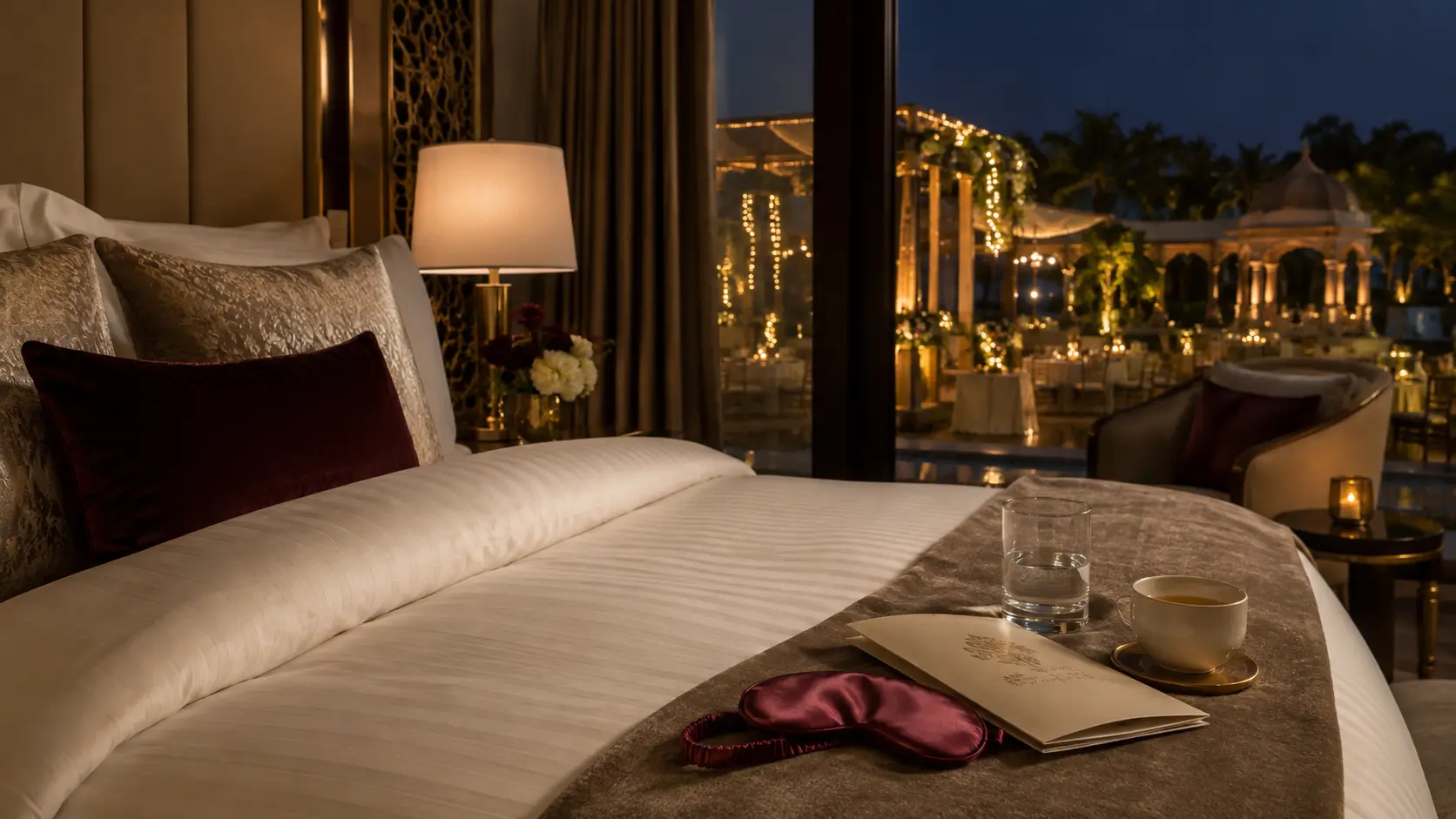
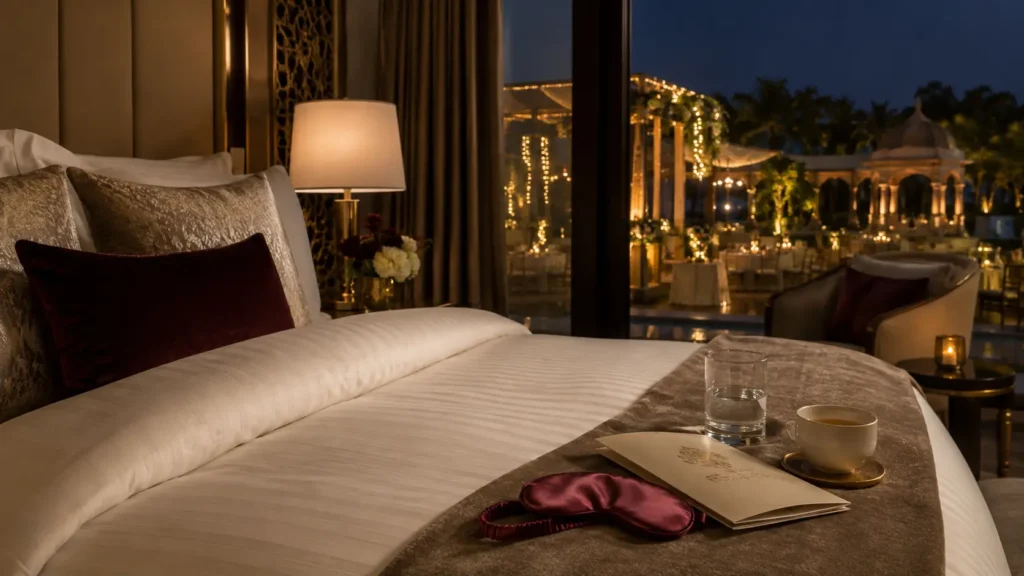
- Offer wellness touches without pressure. A sleep mask on the pillow or a calming tea at turndown works because it is a kindness, not because every guest has to use it.
None of this requires reinventing the wedding weekend. It requires treating rest as part of the guest experience you are designing, not an afterthought guests are expected to manage on their own.
A note on multi-day Bangladeshi and South Asian wedding traditions. Gaye Holud, Mehndi, the wedding day, and the reception already ask a lot of a guest list, often across several consecutive nights, and that is not something to shorten or apologize for. The goal of sleep-aware planning is not fewer events. It is placing genuine recovery windows between them on purpose, so guests arrive at each function with something left to give rather than running on empty by the third night.
Here is a simplified example of what that can look like across a three-day weekend, for illustration rather than as a fixed template:
- Day one: Guests arrive throughout the day. Evening kept light and optional, no mandatory late program.
- Day two: Main ceremony functions happen later in the day, after guests have had a genuine morning to rest, rather than starting early on the heels of a late arrival night.
- Day three: Reception in the evening, with the following morning kept flexible instead of scheduling a mandatory early departure or brunch.
The specifics will always depend on the guest list, the venue, and the family’s own traditions. The principle underneath stays the same either way. For a deeper look at how this fits into a full wedding weekend, our [guide to planning a multi-day wedding in Dhaka] walks through the logistics in more detail.
What this means for Bangladesh’s place on the destination wedding map
Bangladesh is not yet where Bali, Tuscany, or the Maldives are in global destination wedding conversations, but that is changing. Dhaka increasingly hosts celebrations that pull guests from London, Toronto, New York, and the Gulf in the same weekend, and that pattern is only getting more common as the Bangladeshi diaspora grows more established and more able to travel home for major family events. It is part of why more couples are choosing Bangladesh for their destination wedding in the first place, and why we think of the country as something of a hidden gem of Asian destination weddings rather than an afterthought on the regional map.
That shift matters for how weddings here get planned. A wedding that draws guests across six or more time zones is, by definition, an international travel event, not just a local one with some overseas relatives attending. Treating it that way, with real attention to jet lag, sleep environment, and recovery time, is part of what it means to plan at an international standard rather than a purely local one. It is also part of what makes a market credible on the global stage. Beautiful venues matter, but so does planning that understands what it actually takes to bring a dispersed family together well. It is also part of a broader luxury bridal renaissance taking shape in Bangladesh, where guest experience is increasingly treated as seriously as the ceremony itself. For families coordinating from abroad specifically, our page on planning a wedding in Bangladesh from the UK, USA, Europe, or the Gulf goes into more detail on how we approach this.
A framework that travels beyond Bangladesh
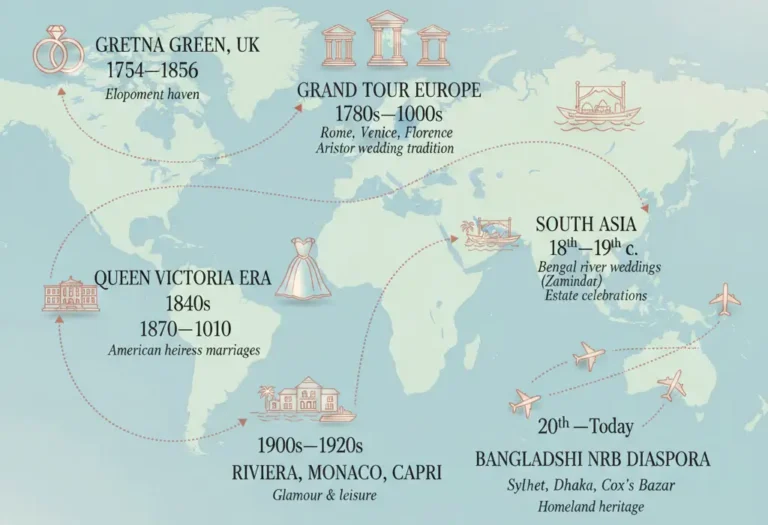
None of the thinking in this piece is unique to Bangladesh. Any wedding that pulls guests across multiple time zones for a multi-day celebration, whether that is an Indian wedding drawing family from three continents, a Nigerian wedding with a diaspora spread across the UK and North America, or a Gulf-based celebration bringing in guests from South Asia and Europe, runs into the same physiology. Jet lag does not check a guest’s nationality before it disrupts their sleep, and the first-night effect does not care which country the unfamiliar hotel room is in. The destination wedding itself, worth remembering, has a longer global history than most people assume, and guest comfort has always been part of that story even when sleep specifically wasn’t.
That is what makes sleep-aware planning a genuinely portable idea rather than a local one. The specific traditions, schedules, and family expectations will always be different from one culture and one wedding to the next. The underlying planning discipline, protecting arrival evenings, building real recovery windows, thinking about where guests actually sleep, does not change from country to country.
We believe this is where destination wedding planning is headed generally, not just in Bangladesh: toward treating guest rest as seriously as guest experience has always treated the ceremony itself. That is the approach Look N Feel – Event Solutions brings to every multi-day and destination celebration we plan, wherever in the world our guests are traveling from. If you are weighing planners for a Bangladesh-based destination wedding, our related pieces on what makes a strong destination wedding planner in Dhaka and what “cheapest” destination wedding planning actually risks cover the planning side in more depth.
Frequently asked questions about Sleep, Jet Lag and Destination Weddings
The best wedding favor might be a good night’s sleep
Every destination wedding sells guests on a beautiful setting and an unforgettable few days. The ones that also protect how guests actually feel while they are there, rested enough to be fully present for the vows, the toasts, and the dance floor, are the ones people remember for the right reasons.
If you are planning a destination wedding and want a weekend your guests can genuinely enjoy rather than simply survive, Look N Feel – Event Solutions would love to help you design it that way. A good place to start is a conversation about where your guests are traveling from and how that should shape the schedule.