Why “How Much Does a Wedding Cost in Bangladesh?” Is the Wrong Question

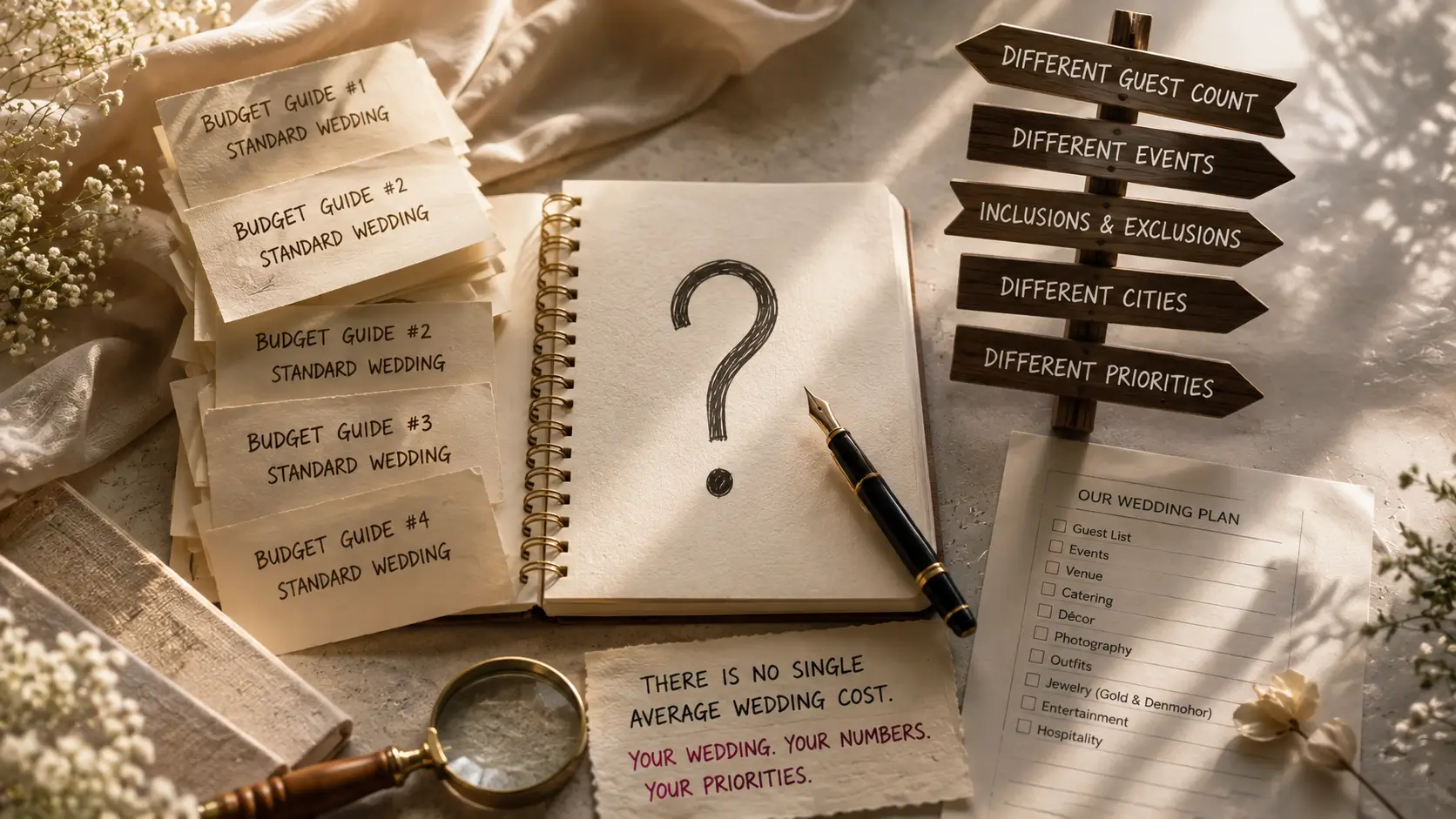
If you’ve searched for a wedding budget figure for Bangladesh this week, you’ve probably walked away more confused than when you started. That’s not because the information is bad. It’s because the question itself doesn’t have one answer, and I want to explain why, then show you what actually does.
Quick takeaways:
- A single afternoon of searching can turn up “standard wedding” figures that differ by five times over, sometimes more, all describing what each source calls the same tier of wedding
- The disagreement isn’t a data problem. It’s because “how much does a wedding cost” is a question with no fixed answer, in the same way “how much does a house cost” has none
- A number that’s too low makes families feel like they’ve failed at something that was never a fixed target. A number that’s too high pushes families toward debt, or toward cutting the wrong things in a panic
- The things that actually determine your number are specific to your family: guest count, how many events you’re hosting, what’s included versus excluded, and where you’re hosting it
- The only budget worth trusting is the one built from your own numbers, not someone else’s average
Quick answer: Published wedding budget estimates for Bangladesh disagree so widely because they describe different things: different guest counts, different numbers of events, different inclusions like gold and denmohor, and different cities. There is no single accurate “average” wedding cost. The number that matters is the one built from your own guest list, event structure, and priorities.
The Four-Question Gut Check
Before you trust any wedding budget figure you see this week, ask it:
-
How many events does it cover?
-
How many guests?
-
Is gold and denmohor included or excluded?
-
Which city is it based on?
Bottom Line: If a page can’t answer those four, it isn’t describing your wedding, no matter how confidently it states its number.
This works even if you got engaged yesterday and haven’t set a guest list, a date, or a single vendor quote yet. It costs nothing to ask, and it’s a better starting point than a number that only feels like a head start.
I Went Looking for “The” Number. Here’s What I Found Instead
If you’ve spent any time this week searching for a wedding budget figure for Bangladesh, you’ve probably seen a version of this: one source calls a “standard” mid-range wedding one number. Click through to another, and the same tier is called something noticeably higher. A third page puts it higher still. By the time you’ve read four or five pages, you’ve seen the same tier of wedding priced at wildly different levels, none of them labeled as unusual, all of them labeled “standard.” For what’s supposed to be the “luxury” tier, the spread only gets wider.
This isn’t old information sitting next to new information. These are all current, all published recently, all claiming to describe the same thing: what a normal Bangladeshi family, in a normal Bangladeshi city, spends on a normal wedding.
They can’t all be right. And here’s the uncomfortable part: they’re not really wrong either. Each of those numbers is probably an honest reflection of somebody’s real wedding. The problem isn’t the numbers. It’s the question.
It’s not just published guides either. Real conversations on Reddit, Quora, and inside Bangladeshi wedding planning groups on Facebook show the same pattern anecdotally: families comparing notes and landing on numbers just as far apart, sometimes within the same thread. That’s real people, not brands with something to sell, unable to agree on what “normal” even means. If actual families who lived through their own weddings can’t settle on a shared number, that should tell you something the published guides can’t: there was never a normal number to settle on.
Why the Numbers Will Never Agree
After nearly a decade and more than 800 events, I can tell you exactly why this happens, and it isn’t because anyone is making things up. Across every one of those events, I have never once seen two families land on the same number, and I stopped being surprised by that a long time ago. A single reception for a few hundred guests and a four-event sequence for six hundred can look similarly beautiful in photographs and still sit in completely different cost universes. Guest count and how many events a family hosts explain more of that gap than taste, venue prestige, or anyone’s idea of “standard” ever will.
“Standard” doesn’t mean the same thing to two different families. One family’s “typical” wedding is a single reception for a few hundred guests. Another family’s “typical” wedding is the full sequence, Gaye Holud, Nikah, the wedding day itself, and Bou Bhaat, each with its own guest list, its own decor theme, and often its own venue entirely. Compare a single-event estimate to a four-event estimate, and of course the numbers won’t match. They were never describing the same thing.
What’s included changes the total more than anything else. Some published figures fold in gold jewelry and denmohor. Others explicitly leave them out, because gold prices move independently of everything else and can dwarf the rest of the budget on their own. A number that quietly excludes jewelry will always look smaller than one that includes it, and neither is lying to you. They’re just answering a different question.
The “free venue” isn’t free, and that skews everything. A venue that waives its booking fee almost always recovers that money through a mandatory per-plate catering minimum, and often through an in-house decorator requirement on top of it. On paper, that venue looks cheaper than one charging a flat rental fee. In practice, it can land at the same total or higher, once the guest count is applied. Two families can book venues that look completely different in price and end up spending nearly the same amount, or two families can book venues that look similar and end up worlds apart, depending on the fine print.
Guest count moves the total faster than any other single decision. This is the one factor that shows up in almost every serious breakdown, and for good reason. Catering is charged per plate. Add a hundred guests and you’ve added a meaningful chunk of money before you’ve touched decor, photography, or anything else. Two families with identical taste and identical vendors can land on wildly different totals purely because one invited two hundred people and the other invited six hundred.
Location changes the market underneath you. Vendor rates, venue availability, and transport logistics in Dhaka behave nothing like they do in Sylhet, Chattogram, or a coastal destination wedding. A number benchmarked against the capital will not translate cleanly anywhere else in the country.
If you’re planning from abroad, the noise gets louder. For families planning from London, Toronto, Dubai, or anywhere else, a published number often carries more weight than it should, simply because you can’t walk into a venue yourself to check it. Currency conversion adds another layer of confusion on top, and a figure that already meant something different to the site that published it means something different again once it’s been mentally converted from Taka. The instinct to trust a number more because you’re far from the source is understandable. It’s also exactly backwards, and it’s the same instinct behind the vendor markups we see NRB families walk into most often.
None of this means anyone publishing these figures is being careless. It means a single number was always going to flatten a dozen decisions that only your family gets to make, the same pattern behind the budgeting mistakes we watch families make in Dhaka, where the problem is rarely carelessness either. It’s a decision made against the wrong reference point.
The Wedding Budget Confusion, Decoded
Once you know what to look for, you can spot this in seconds on any page you land on next. Most published figures use soft, confident-sounding labels without ever stating what those labels are quietly assuming. Here’s what’s usually hiding behind them:
| The label you’ll see | What it’s usually silently assuming |
|---|---|
| “Simple” or “budget” wedding | Often one event only, a smaller guest list, and family gold rather than newly purchased jewelry. |
| “Standard” or “mid-range” wedding | Usually assumes more than one event, but rarely states whether gold or denmohor are included in the figure. |
| “Luxury” or “premium” wedding | Usually assumes a five-star or premium venue, but “premium” itself has no fixed guest count or event count behind it. |
| A figure with no guest count stated | Almost certainly wasn’t built around your guest list, whatever the label says. |
| A figure with no city stated | Almost certainly built around Dhaka pricing, whether or not the page says so. |
None of that makes the label wrong. It just means the label was never enough information to act on by itself, which is exactly what the four-question gut check above is for.
What a Generic Number Actually Does to You
This is the part that matters more than the math.
A number that’s too high reads as failure. If you’re planning something modest and you come across a figure well above what you’re comfortable spending, it doesn’t read as “that’s someone else’s situation.” It reads as failure. Families start to feel like they’re doing something wrong, or that they’re embarrassing themselves in front of relatives, simply because their real, reasonable budget doesn’t match a number that was never describing their wedding in the first place. That fear pushes people toward decisions they can’t actually afford, taking on debt, or adding events and extras they didn’t want, purely to close the gap between their number and a stranger’s number.
A number that’s too low creates a different kind of damage. A family anchors on a lower published figure, assumes it covers everything, and then gets blindsided midway through planning when it turns out that number quietly excluded jewelry, or assumed a single event instead of three, or was based on a city where vendor rates run lower than where they’re actually hosting. That’s not a budgeting mistake on their part. That’s a mismatch between the number they trusted and what it was actually describing, and it shows up as unpleasant surprises exactly when there’s the least room to absorb them.
Neither outcome is really about money. It’s about a number doing the job that only a real conversation with your own family can do.
What Actually Determines Your Number
None of this means budgeting is guesswork. It means the inputs that matter are yours, not a website’s. The families I work with who plan the most calmly are the ones who start with these questions before they start with a figure:
7 Questions to Ask Before Setting Your Budget
-
How many events are you actually hosting, and are any of them being combined to save on venue and decor costs?
-
What’s your realistic guest count, per event, not just for the largest one?
-
Are jewelry and denmohor part of this budget conversation, or being planned separately?
-
Is your venue charging a flat fee, or waiving it in exchange for a catering minimum you need to calculate against your real guest count?
-
Are you hosting in Dhaka, or somewhere with a different vendor market entirely?
-
Which categories matter most to your family, and which ones are you genuinely comfortable simplifying?
-
If you’re planning from abroad, who on the ground can actually verify a quote for you before you commit to it?
Answer those honestly, and you’ll have something far more useful than any published tier: a shape for your own wedding that no comparison to someone else’s number can distort.
The Real Calculation Sequence
-
Step 01
Guest count
-
Step 02
Number of events
-
Step 03
Inclusions (gold, denmohor)
-
Step 04
Venue type
-
Step 05
Location
-
Result
Your real number
That’s the actual chain. Every published figure you’ll find skipped straight from the first step to the last, which is exactly why none of them agree.
If your honest answer to “which categories matter most” is “most of them,” our approach to budget-friendly event planning in Bangladesh goes further into where elegance and cost actually part ways. And if you’re trying to work out what a planner’s involvement would even add to these numbers, our guide to event planner prices and packages in Dhaka breaks that down separately.
Build Your Own Number, Not Someone Else’s
Your wedding was never going to match a number pulled from thousands of other families’ decisions, because it was never describing your guest list, your city, your priorities, or your family’s traditions. That’s not a flaw in the number. It’s just not the right tool for what you’re actually trying to do.
What you need instead is a working total built from your own figures, one you can update the moment a real venue quote or catering estimate comes in, and one that shows you immediately whether your plan is on track, before a single deposit is paid. That’s the entire idea behind our free wedding budget calculator for Bangladesh weddings. It won’t tell you what a wedding “should” cost. It will help you see, clearly and in Taka, what yours actually does.
If you want the full system behind that number, guest count, event count, and inclusion scope, the three forces that build every wedding budget, I wrote out the complete framework separately: Wedding Budget Bangladesh: The Complete Framework.
The Percentage Rules and Apps You’ll Find Online Weren’t Built for This
Search around long enough and you’ll also come across generic wedding budgeting advice: a fixed percentage split for savings and spending, or guidance to put a set share of your total toward venue and catering, another share toward photography, and so on. You’ll find global apps built around that same structure too, designed for a single ceremony and a single reception, planned and tracked in a single currency.
None of that is wrong, exactly. It’s just built for a different wedding than the one most Bangladeshi families are planning. A percentage split designed around one event doesn’t have anywhere to put a Gaye Holud, a separate Nikah, and a Bou Bhaat, each with its own guest list and its own decor. It doesn’t have a category for denmohor, and it usually doesn’t account for gold moving independently of everything else you’re spending. Importing a framework built for a different wedding structure onto a Bangladeshi one doesn’t make your budget more accurate. It just adds another number that was never describing your wedding in the first place.
This is exactly the gap our free wedding budget tool was built to close: a category for every event in the sequence, denmohor and gold accounted for as their own lines, built around the wedding you’re actually hosting instead of the one a generic template assumes.
Frequently Asked Questions about Wedding Budget Myths in Bangladesh
If you’re in the middle of planning and want to see where you actually stand before you commit to a venue or vendor, start with your real guest list and event structure in our free wedding budget calculator. If you’d like a second, experienced pair of eyes on what it shows you, I’m happy to walk through it with you.
Your wedding doesn’t need to match an internet average. It needs to match you. — Nowshin Jahan, Founder & Celebration Strategist, Look N Feel – Event Solutions