Wedding Budget Bangladesh: The Complete Framework for Building Your Celebration Budget

Every family planning a wedding in Bangladesh eventually ends up with the same browser tabs open: a few cost guides that don’t agree with each other, a spreadsheet template built for a wedding in a different country, and a copy of whatever a cousin used two years ago. None of that is a plan. It’s a pile of other people’s decisions with no structure underneath them.
At Look N Feel, we have planned weddings across Dhaka, Sylhet, Chattogram, and Cox’s Bazar for nearly a decade. We have worked with families who live down the street and families who plan from London, Toronto, and Dubai. The families who finish planning calmly are not the ones who found the perfect internet number. They are the ones who built a framework first.

This guide is that framework. It is not a price list. It is a system. It will show you how guest count, event structure, inclusions, location, and coordination style connect to one another. It will give you a way to think about your budget that no published average can distort.
What you will find here:
- The Wedding Budget Triangle: the three forces that determine every number
- Three family archetypes we see in Bangladeshi celebrations
- What to include, what to separate, and why the difference matters
- How location changes your vendor landscape
- A 90-day budget build timeline
- How to use a budget calculator that matches your actual wedding structure
Quick answer: A wedding budget in Bangladesh is determined by the intersection of three forces: how many guests you invite, how many events you host, and what you choose to include inside the budget. Location and coordination style shape how those forces play out. There is no reliable average across all five variables. The only useful budget is the one your family builds from its own decisions.
Why this guide does not list a wedding-cost figure. Search “wedding budget Bangladesh” and you’ll find numbers. Those numbers aren’t wrong, they’re just answers to questions you aren’t asking. Every published figure assumes a guest count, an event count, and an inclusion list that may not match yours. This guide gives you the framework to build your own number instead of borrowing someone else’s.
Which of these sounds like you?
Select your planning situation to jump straight to the tailored section.
“We’re keeping the guest list tight and want gathering over grandeur.”
“We’re hosting the full sequence across several days.”
“We’re planning from abroad and need to trust what we can’t see in person.”
“I just want to understand the framework first.”
About this guide. Written by the team at Look N Feel – Event Solutions, Dhaka, Bangladesh. We’ve planned weddings across Dhaka, Sylhet, Chattogram, and Cox’s Bazar since October 2016, for local families and families planning from London, Toronto, Dubai, and beyond. This framework is built on nearly a decade of real weddings, not averages pulled from the internet.
Why Published Wedding Budgets for Bangladesh Disagree
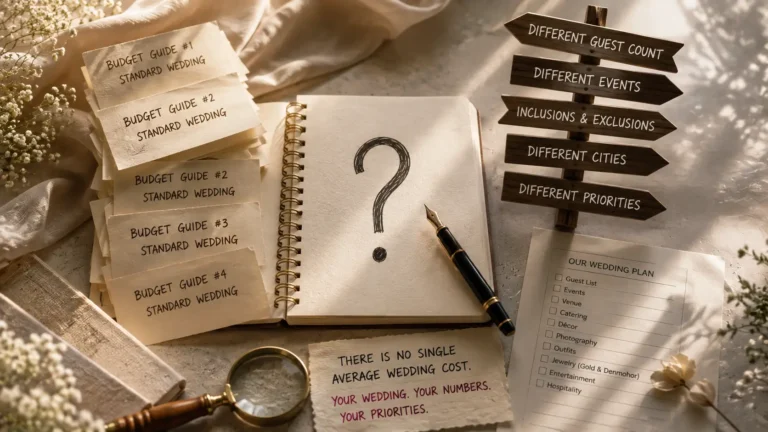
The first thing to understand is that the disagreement is not a data problem. It is a definition problem. Search for a wedding budget figure and you’ll find one site calling a “standard” wedding one number, another calling the same word something noticeably higher, and a third handing you a spreadsheet built for a wedding in a different country entirely. None of them tell you what guest count they assumed, whether they counted Gaye Holud and Nikah as separate events, or if gold and denmohor were inside or outside the number.
A figure that assumes one reception for two hundred guests will always look smaller than a figure that assumes Gaye Holud, Nikah, wedding day, and Bou Bhaat for six hundred guests. A figure that excludes gold jewelry and denmohor will always look smaller than one that includes them. A figure built around Dhaka vendor rates will not translate to Sylhet or Chattogram. A figure built for a local family will not account for the verification gap that NRB families face.
None of those figures are wrong. They are just answering different questions. And when you search for a single number, you are asking a question that has no single answer.
If you want to understand the full mechanics of why every published figure you have seen online will mislead you, read our deep dive: why the average wedding cost in Bangladesh is a myth. It explains the psychology of why families panic when their real budget does not match a stranger’s number, and why that panic leads to debt, family tension, and decisions no one wanted.
How this post and the myth post work together: this guide is the starting point, the framework, the system, the decision tree. That post is the deep dive into why chasing an average was the wrong starting point in the first place. Read them in either order; each stands on its own, and each points to the other.
The Wedding Budget Triangle
Every wedding budget we have built rests on three points. Shift one, and the others move. Understand the Triangle, and you stop chasing numbers that were never built for your wedding.
In plain words: invite more guests or add more events, and something else usually has to give, often the budget for extras like decor or outfits. Want everything included? You’ll likely need a shorter guest list or fewer days. You don’t need to touch the diagram to follow this; the three points below walk through exactly what it means for your own wedding.
Ready to apply this to your own wedding? Our wedding budget calculator for Bangladesh is built around this exact Triangle: a separate line for every event, a separate guest count for every event, and denmohor and gold tracked as their own categories. Once you’ve read through the three points below, it’s the natural next step.
Point One: Guest Count
Guest count is the base of the triangle. It affects catering, venue size, seating, invitations, service staff, parking, and photography team size. Two families with identical taste and identical vendors can end up in completely different logistical situations because one invited two hundred people and the other invited five hundred.
The mistake most families make is adding the bride’s list and the groom’s list and calling that the total. In practice, a meaningful share of any Bangladeshi wedding list overlaps. Cousins know both families. Colleagues are invited to multiple events. Neighbors attend everything. The families who account for this overlap plan venues accurately. The families who do not end up with halls that feel empty or seating charts that fall apart.
The Wedding Plate Overlap Formula
Total plates = (Bride’s list + Groom’s list) – Confirmed overlap. This is arithmetic on your own two lists. Stop guessing and stop overbooking the caterer.
What to do: Count guests per event, not as one total. Then identify the overlap. That overlap is what saves you from overbooking space and overpaying for plates.
Point Two: Event Count
A Bangladeshi wedding is rarely one event. It is a sequence that can draw from a much longer list than most families realize at the start: Engagement or Proposal Party, Mehndi or Henna Night, a Sangeet, Gaye Holud, a Bridal Shower or Aiburo Bhaat, a Bachelors’ Night, Nikah or Akdh, the wedding day, Bou Bhaat or Reception, and sometimes Walima. Many families also host a Firani afterward, a smaller, more home-style follow-up gathering, though whether this happens and at what scale varies by family. No family hosts all of these, and that’s the point: the first decision isn’t how much to spend, it’s which of these you’re actually hosting at all.
Once you know which events you’re hosting, each one typically happens on a separate day, with its own venue booking, decor setup, catering coordination, and photography coverage.
This means your budget is not just about one day of spending. It is about the cumulative cost of a sequence. The decorator who installs the Holud stage on Thursday needs to return for the reception stage on Saturday. The photographer who covers the Nikah on Friday morning needs to be present again for the wedding ceremony on Saturday evening. The bride needs an outfit for each event, not one dress for the entire celebration.
Some families try to combine events onto a single day to reduce venue costs. In our experience, this is rare and often creates more problems than it solves. The bride needs time to change between ceremonies. The Kazi’s availability is tied to prayer times. The groom’s family needs time to travel between venues. Spreading events across multiple days is the norm in Bangladesh, and your budget should reflect that reality.
What to do: Start by listing which events from the fuller list above you’re actually hosting, not which ones exist. Then list every event you’ve chosen on its own day, and count the venue, decor, catering, and photography for each day separately. Then look for overlaps: the same photographer covering multiple days, the same decorator doing two events, the same venue hosting back-to-back functions. Those overlaps are where you find savings, not by compressing the timeline.
Point Three: Inclusion Scope
This is where published figures hide their biggest assumptions. Some budgets include gold jewelry and denmohor. Others exclude them because gold prices move independently and can shift the total unpredictably. Some include the bride’s and groom’s outfits across all events. Others treat clothing as a separate family purchase. Some include honeymoon travel. Others do not.
Before you compare your budget to any figure online, define your perimeter. What is inside the budget? What is outside? A number that excludes jewelry will always look smaller than one that includes it. That does not mean one family is spending less. It means they are drawing the line in a different place.
What to do: List every category that could belong in your budget. Mark each one as inside, outside, or undecided. That list is your perimeter. Do not let a published figure redraw it for you.
Three Family Archetypes We Work With
Instead of price tiers, we think in terms of decision-making styles. These three archetypes describe most of the families who come to us. See which one matches yours.
Intentional Minimalists
Tradition Keepers
Distance Planners
The Intentional Minimalists
These families want gathering over grandeur. They typically host one or two events, keep the guest list tight, use family gold rather than newly purchased jewelry, and choose a community venue or family home over a commercial hall. Their budget perimeter is narrow by choice. They spend on food and photography, simplify decor, and prioritize guest comfort over visual spectacle.
Their biggest risk: The guest list grows after the first round of invitations. Even minimalists in Bangladesh face pressure to include relatives. Build a firm list early and agree on a cutoff date.
The Tradition Keepers
These families host the full sequence: Holud, Nikah, wedding day, and Bou Bhaat or Reception. Each event has its own guest list, its own venue, and its own dress code. The bride may change outfits three or four times. The groom’s family travels between locations. The budget perimeter is wide because every category is included.
Their biggest risk: Logistics coordination. The gap between the Nikah and the Walima, the bride’s changing room, the photographer’s schedule across venues, and the decorator’s teardown and setup time are what determine whether the day feels calm or chaotic. Their budget is not just about spending. It is about timing.
For a complete guide to planning every stage of a Bangladeshi wedding, see our Bangladesh wedding planning guide.
The Distance Planners
These families live abroad and are organizing a wedding in Dhaka, Sylhet, or Chattogram from London, Toronto, Dubai, or Sydney. They often host larger celebrations because they are bringing together relatives from multiple countries. Their budget perimeter is wide, but their biggest challenge is verification. They cannot walk into a venue to check capacity. They cannot taste the catering menu. They are relying on photos, videos, and relatives who mean well but may not know what to verify.
Their biggest risk: Trusting a published figure more heavily because they are far from the source. Distance makes every number feel more certain than it is. A figure you cannot verify against a real quote is a placeholder, not a plan.
If you are planning from abroad, our guide to planning an international event in Bangladesh was built specifically for your situation. And for the vendor markups that distance makes invisible, read Hidden Vendor Markups for NRB Families.
Dhaka vs Outside Dhaka: How Location Changes Your Landscape
Vendor behavior, venue structures, and logistics change significantly depending on where you host. Select a location to see key operational differences.
Widest network of specialized service providers.
Most complex pricing models to compare accurately.
Rarely needed for primary events.
Dhaka
- Vendor availability is the widest in the country. You have more choices for catering, decor, photography, and sound.
- Traffic is a default condition, not an exception. Travel time between venues must be built into your timeline.
- Venue pricing structures vary the most. Some charge flat rental fees. Others waive the fee but require minimum per-plate catering and in-house decorators. The second structure often looks cheaper on paper but converges with the first once guest count is applied.
- Parking is frequently shared across multiple events in the same complex. Always ask how many cars the lot holds and whether other weddings are scheduled the same day.
For a list of venues we have worked with across Dhaka and what to ask before booking any of them, see Event Venues We Have Worked With Across Dhaka and What to Ask Before Booking an Event Venue in Dhaka.
Sylhet
- In our experience, Sylhet celebrations often involve families coordinating from abroad, which makes accommodation and remote decision-making a bigger factor than in Dhaka.
- Venue options are more limited than Dhaka, which means earlier booking is essential.
- Guest accommodation is a bigger factor. Out-of-town relatives need blocks of rooms, which should be arranged before decor or catering decisions.
- Local vendor networks are strong but less flexible than Dhaka. Customization requests may need more lead time.
Chattogram
- Port city logistics affect transport timing. Decor and catering vendors from Dhaka may charge travel fees or decline if the timeline is tight.
- Beach and hillside venues outside the city offer unique settings but require contingency plans for weather.
Cox’s Bazar and Coastal Destinations
- The most weather-dependent option. Outdoor events need solid backup plans.
- Vendor travel from Dhaka adds cost and complexity. Local vendors exist but are fewer.
- Guest accommodation is not optional. It is part of the event structure.
- Permits and venue access can take longer than in major cities.
Rajshahi, Khulna, Barisal, Rangpur, and Mymensingh
We work with families across Bangladesh, but our direct, day-to-day operational knowledge is concentrated in Dhaka, Sylhet, Chattogram, and Cox’s Bazar, so we’ll be straightforward about the difference: what follows is general planning guidance for these five divisions, not the same first-hand market detail we can offer for the four above.
- Vendor networks tend to be smaller than in the major hubs, which means less price and package variation to compare, and earlier booking matters more than it does in Dhaka.
- Many families in these divisions either work with local vendors directly, bring a coordination team from Dhaka, or do both, splitting the work between local execution and remote-managed categories like photography or specialty decor. Decide this early, since it changes both your timeline and who’s responsible for what.
- Distance from a major transport hub tends to be the biggest single variable. A venue an hour from a divisional city behaves very differently than one that’s a half-day’s travel away, in ways that affect guest accommodation, vendor travel, and setup time more than the wedding itself.
- If your family is planning in one of these divisions and wants a local, on-the-ground perspective specific to your area, we’d rather say so upfront than guess: ask us directly, and we’ll tell you honestly what we can and can’t speak to from experience.
For more on planning celebrations outside Dhaka, explore our Destination Wedding Guide.
The 90-Day Budget Build
We recommend building your budget in three phases. Each phase has a clear output. Skip a phase, and you collect quotes before you know what you are quoting for.
Days 1 to 30: Define the Triangle
Output: A completed Wedding Budget Triangle document.
- Settle the number of events and whether any can be combined.
- Build a realistic guest list per event, accounting for overlap.
- Draw your inclusion perimeter. What is inside the budget? What is outside?
- Choose your location and understand its vendor landscape.
- Decide your coordination style: self-managed, partially supported, or fully planned.
Most common failure if skipped: Calling vendors before the Triangle is settled. The quotes that come back are for a wedding you haven’t actually defined yet, so they end up impossible to compare against each other.
Do not call a single vendor until this document is complete.
Days 31 to 60: Collect Structured Quotes
Output: A quote comparison table with the same categories across every vendor.
- Request quotes for venue, catering, decor, photography, and coordination.
- For each quote, note what is included and what is extra. A lower quote that excludes setup time, overtime, or service staff is not cheaper. It is just shorter.
- Verify venue details in person if you are in Bangladesh. If you are abroad, send a trusted representative.
- Update your calculator with real numbers as they arrive.
Most common failure if skipped: Accepting the lowest number on a quote without checking what it excludes. Two quotes that look close on paper often turn out to be quoting different scopes of work entirely.
For the most common errors families make during this phase, read Event Budgeting Mistakes in Dhaka.
Days 61 to 90: Lock, Buffer, and Confirm
Output: A locked budget with a contingency reserve.
- Finalize your guest list. No additions after this point.
- Confirm vendor contracts. Read the fine print on catering minimums, overtime penalties, and vendor exclusivity clauses.
- Set aside a contingency reserve before locking anything. How much depends on how fixed your guest list, venue terms, and vendor commitments already are.
- Build a day-of timeline that accounts for travel, setup, and transitions between events.
Most common failure if skipped: Letting the guest list keep growing after this point. A finalized budget with an unfinalized guest list isn’t actually finalized, it just feels that way until the last invoice arrives.
The Inclusion Decision Tree
Not every family includes the same categories in their wedding budget. Before you run anything through the tree below, here’s the full list of categories worth having an opinion on. Most guides organize this list by what things cost. We organize it by what you actually decide:
Vendor-side categories (almost always inside the event budget): Venue, catering, service staff, decoration, sound system, lighting, DJ or musicians, seating and table setup, entertainment, photography and videography, invitation cards.
Personal or family categories (worth deciding on purpose, not by default): Bride’s and groom’s attire, jewelry and gold, makeup and salon, accommodation for out-of-town guests or family, gifts and sweets for the dala or guest favors, transport for the couple and family.
Legal and religious categories (usually tracked separately): Kabin registration fee, Kazi’s professional fee, denmohor.
Everything else: Miscellaneous and contingency.
None of these categories has a fixed answer for whether it belongs in your budget. That’s exactly what the tree below is for.
- Yes, happens during the events (venue, catering, service staff, decor, sound, lighting, DJ, entertainment, seating/tables, photography, invitations)→ INCLUDE in budget
- Yes, worn or used by the couple (outfits, makeup, hair, jewelry)→ FAMILY DECISION: some include, some separate
- Yes, but for guests or family, not the event itself (accommodation, transport, gifts and sweets for the dala)→ FAMILY DECISION: often tracked separately from vendor spending
- Yes, a legal or religious requirement (Kabin registration fee, Kazi’s professional fee, denmohor, documentation)→ FAMILY DECISION: denmohor especially is often kept separate, negotiated between families rather than spent on vendors
- No, a family asset (inherited gold, property, long-term investments)→ EXCLUDE from event budget
- No, it’s post-wedding (honeymoon, new home setup)→ EXCLUDE from event budget
The families who plan calmly are the ones who make these decisions early. The families who panic are the ones who discover midway through planning that their budget was missing a category they assumed was included.
The Coordination Spectrum
How you manage the wedding changes your stress level more than your spending. Answer this first: how many events are you hosting, and can someone attend vendor meetings in person? That single pair of answers points you toward one of the three options below.
Self-Managed: The couple or family handles every vendor conversation, every contract, and every timeline decision. This gives full control. It also means every problem is yours to solve. Best for single-event celebrations with short guest lists and local families who can visit vendors in person.
Partially Supported: A day-of coordinator or venue liaison handles execution on the wedding day, but the family manages all planning and vendor selection. This reduces day-of stress without adding a full planning fee. Best for families who enjoy planning but want professional backup when the wedding procession is delayed or the decorator is stuck in traffic.
Fully Planned: A planner manages vendor selection, contract negotiation, timeline creation, and day-of coordination. The family makes decisions. The planner executes. Best for multi-event celebrations, large guest counts, destination weddings, and NRB families who cannot be on the ground for vendor meetings.
What to know: The coordination style does not just affect your budget. It affects your timeline, your communication rhythm, and your stress level. A couple making decisions with parents in Toronto needs a different communication structure than a couple visiting vendors on Saturday afternoons.
For a full breakdown of what different planning levels include, see our Complete Guide to Event Planner Prices and Packages in Dhaka.
How to Use a Wedding Budget Calculator That Matches Your Structure
Most wedding calculators are built for a single ceremony and reception. A Bangladeshi wedding does not fit that shape. It has multiple events, overlapping guest lists, and categories that generic templates ignore.
A calculator built for Bangladeshi weddings should have:
- A separate line for every event in your sequence
- Per-event guest counts, not one total
- Categories for denmohor and gold, separate from vendor costs
- A distinction between venue types (flat fee vs minimum catering vs full package)
- A cost-per-guest calculation that updates as you enter real quotes
- A running total and a remaining balance
Our Wedding Budget Calculator for Bangladesh was designed around this structure. It does not tell you what a wedding should cost. It shows you what yours costs, based on the decisions you have already made.
If you are also looking for ways to reduce costs without reducing quality, our Budget-Friendly Event Planning Guide covers where elegance and cost actually part ways.
Frequently Asked Questions about the Wedding Budget Triangle
Your wedding does not need to match an internet average. It needs to match you. If you’re ready to turn this framework into your own working budget, start with our Wedding Budget Calculator for Bangladesh: bring your guest counts, your event sequence, and your inclusion perimeter, and it builds the number from there. If you’d like an experienced team to review your framework before you lock anything in, we are here.