The Ultimate Guide to Bangladeshi Wedding Menus: Catering Formats and Event-by-Event Food, Explained
A note on scope: this guide reflects general patterns seen across Dhaka and wider Bangladesh. Practices vary by region, family tradition, and community, and this content is offered to help couples understand their options, not as a service we provide directly. No specific hotels, restaurants, halls, or baburchi businesses are named, and no prices are included.
Planning a Bangladeshi wedding means navigating a lot more than one caterer and one menu. Depending on the family, a wedding can involve anywhere from four to nine separate programs, each with its own food expectations, and the venue format you choose (hotel, hall, baburchi, home, outdoors, or resort) shapes what’s actually possible to serve. This guide breaks both of those down: the nine catering formats available in Bangladesh, and how the menu shifts from one wedding event to the next. For the wider planning picture beyond catering, see our complete guide to planning a wedding in Bangladesh and our guide to choosing the right wedding planner in Dhaka.
Key takeaways: Bangladeshi weddings use 9 main catering formats (hotel, hall, baburchi, buffet restaurant, Chinese restaurant, home, outdoor, resort, plus head table upgrades) and can include 4–9 separate programs, each with its own menu expectations. Hotels and resorts suit formal, single-vendor convenience; baburchi and home catering suit authenticity and cost flexibility; Chinese restaurants suit variety and convenience; halls sit in between. No format is universally “best” — the right choice depends on guest count, budget, and how much coordination the family wants to manage directly.
Quick Comparison: The 9 Formats at a Glance
This is a starting point for narrowing your catering options in Bangladesh, not a substitute for the detail in the individual sections below. “Guest scale” and “cost level” are relative to each other, not fixed numbers, since actual scale and pricing depend heavily on the specific Dhaka venue, region, or caterer selected.
Hotel Catering
- Guest Scale
- Medium–Large
- Relative Cost Level
- Higher
- Customization
- Moderate, within packages
- Cooking Style
- In-house kitchen
- Setup Effort
- Low (hotel handles it)
- Weather Risk
- None (indoor)
- Best For
- Formal receptions, NRB remote planning
Community Hall
- Guest Scale
- Large–Very Large
- Relative Cost Level
- Moderate
- Customization
- High
- Cooking Style
- On-site, caterer-brought
- Setup Effort
- High (couple coordinates)
- Weather Risk
- Low (mostly indoor)
- Best For
- Large traditional weddings, budget flexibility
Baburchi
- Guest Scale
- Small–Very Large
- Relative Cost Level
- Lower–Moderate
- Customization
- Very high
- Cooking Style
- Traditional, on-site
- Setup Effort
- High
- Weather Risk
- Depends on venue
- Best For
- Authentic flavor, home or hall settings
Buffet Restaurant
- Guest Scale
- Small
- Relative Cost Level
- Lower
- Customization
- Low
- Cooking Style
- Restaurant’s own kitchen
- Setup Effort
- Low
- Weather Risk
- None (indoor)
- Best For
- Small, informal gatherings
Chinese Restaurant
- Guest Scale
- Small–Medium
- Relative Cost Level
- Lower–Moderate
- Customization
- Low–Moderate
- Cooking Style
- Restaurant’s own kitchen
- Setup Effort
- Low
- Weather Risk
- None (indoor)
- Best For
- Variety-focused guests, convenience over tradition
In-House (Home)
- Guest Scale
- Small–Medium
- Relative Cost Level
- Lower
- Customization
- Very high
- Cooking Style
- Home or temporary setup
- Setup Effort
- Very high (falls on family)
- Weather Risk
- Moderate if partly outdoor
- Best For
- Holud, intimate family events
Outdoor Events
- Guest Scale
- Medium–Large
- Relative Cost Level
- Moderate–Higher
- Customization
- High
- Cooking Style
- Live stations, temporary kitchen
- Setup Effort
- Very high
- Weather Risk
- High
- Best For
- Holud, Mehndi, photogenic events
Resort Catering
- Guest Scale
- Medium–Large
- Relative Cost Level
- Higher
- Customization
- Moderate
- Cooking Style
- Resort in-house
- Setup Effort
- Low (resort handles it)
- Weather Risk
- Low–Moderate
- Best For
- Multi-day, destination-style, NRB gatherings
Head Table Add-On
- Guest Scale
- N/A, add-on only
- Relative Cost Level
- Adds to base cost
- Customization
- Item-specific
- Cooking Style
- Depends on base format
- Setup Effort
- Depends on base format
- Weather Risk
- Depends on base format
- Best For
- Any format, as an upgrade
1. Hotel Catering (Buffet-Style, with Custom Menu Options)
In short: the hotel’s own kitchen and staff plan, cook, and serve the food as part of one bundled package, best for the main wedding (biye), formal receptions, and couples who want single-vendor convenience.
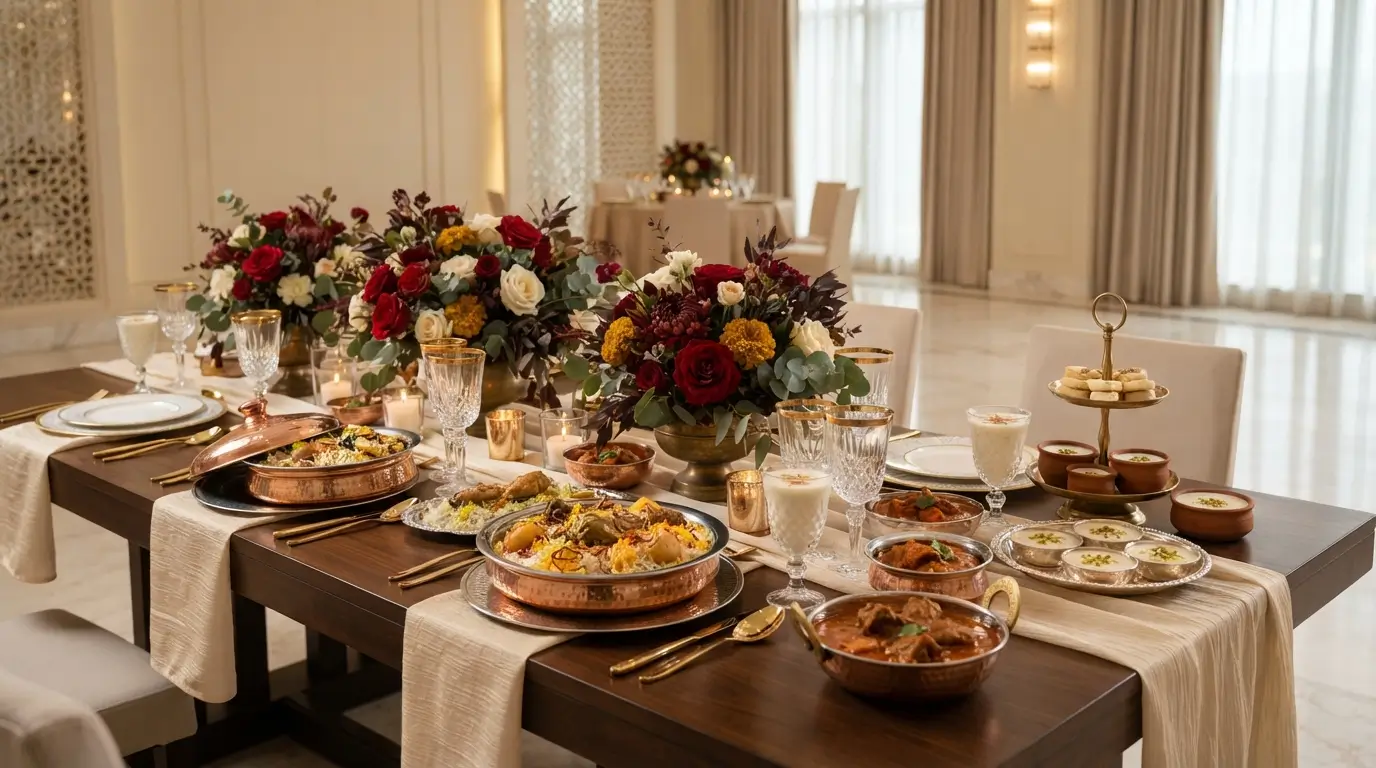
What it is: The venue’s own culinary and banquet team plans, cooks, and serves the food as part of a package that also covers the hall itself. Couples typically choose from tiered buffet packages and customize within them, though how much customization is allowed varies by property.
Typical menu: Welcome drinks (borhani, mocktails, juices); starters (kebabs, fish fry, spring rolls); a rice centerpiece (polao or kacchi biryani); meat and fish mains (chicken roast, beef or mutton rezala, a fish preparation); vegetables; salad and chutney; a dessert spread (firni, mishti doi, rasmalai). Live counters (kebab, fuchka) are increasingly common add-ons.
Two ways hotels serve the meal: One is a seated arrangement, where servers bring the food to the table rather than guests collecting it themselves. The other is a full buffet, where guests move between stations and choose their own items. Pricing in both cases generally depends on the number of items included in the package.
A note on beverage stations: Hotels commonly offer a separate tea or coffee station rather than pre-mixed drinks. Hot black coffee or tea, milk, sugar, and zero-calorie sweetener options are typically kept separate so guests can prepare their own cup.
Service and logistics: Hotel staff handle setup, service, and teardown entirely. Menus and guest counts are usually finalized well in advance. Event slots are typically time-limited, since hotels run back-to-back bookings.
Pros and cons: Strong on consistency, presentation, and single-vendor convenience, especially useful for NRB couples coordinating remotely. Weaker on flexibility for highly customized or rustic traditional dishes, and subject to fixed time windows. Best suited to the wedding day (biye), formal larger receptions, and families who want one accountable vendor.
What people ask:
Can hotel wedding menus be customized for dietary needs or foreign guests? Most hotel banquet teams can accommodate vegetarian, low-spice, or allergen requests, but this needs to be arranged during the tasting and planning stage, not on the event day itself. If a full buffet is chosen rather than a seated arrangement, accommodating individual guest needs tends to be easier.
Do hotels allow an outside baburchi to cook inside their venue? No, hotels generally don’t allow this. They require using their in-house catering team as part of the venue contract, so confirm this before booking if a baburchi-style menu matters to you.
Is hotel catering suitable for Holud? It can be, but Holud traditionally has a more informal, colorful, floor-seating feel that some families feel doesn’t translate well to a formal ballroom. Many choose a hotel for the main wedding day or reception and a home or outdoor setting for Holud.
2. Community Centers and Convention Halls
In short: these are two different venue types with different catering rules, community centers usually let you bring your own caterer or baburchi, while convention halls usually require using the venue’s own selected caterer.
What it is: Rented halls that supply the physical venue, seating, and basic infrastructure. Whether catering is included depends on which type of venue this is. Convention halls typically have their own selected or preferred caterer, and in most cases (roughly 95% of the time) the client is expected to use that caterer rather than bringing one in. Community centers more often rent the space only, without a required caterer, giving the family the option to bring their own baburchi. This distinction should be confirmed directly with the venue before booking, since practice varies.
Typical menu: Whatever the caterer brings, but common hall spreads include kacchi biryani or polao, jali or shami kebab, chicken roast, beef and mutton curries, a fish dish, and borhani, though some venues substitute a 250ml soft drink for borhani to reduce cost. Salad (piece or mixed) and a sweet like firni or jorda round out the meal, and some caterers add ice cream in summer.
Service and logistics: The caterer brings their own cooking and serving staff, and cooking is frequently done on-site in a temporary setup (large pots, portable stoves) or nearby. Setup can take a full day; teardown and cleanup are separately negotiated. Space, generator backup, and kitchen access vary a lot by hall.
Pros and cons: Strong on flexibility, scale, and cost control at community centers specifically, since food and venue can be shopped independently there. Weaker on coordination burden, since the couple manages venue, caterer, and decor as separate vendors, and quality depends entirely on who’s hired. Best for large guest lists, budget-conscious families who still want traditional dishes, and multi-day weddings held at the same hall.
Common questions:
Do convention halls in Dhaka include catering? Convention halls typically already have tables and chairs set up, and in most cases, roughly 95% of the time, the client is required to use the venue’s own selected caterer rather than an outside one.
Do community centers in Dhaka include catering? Usually not. Most centers rent the space only, sometimes with basic tables, chairs, and generator backup, while catering is arranged separately. Always confirm what’s included before booking.
Can a baburchi cook on-site at a rented hall? At a community center, many allow on-site cooking in a designated back area, but not all do, and some require food to be cooked off-site and transported in. This affects both freshness and which dishes are realistic to serve. At a convention hall, this is generally moot since the venue’s own caterer handles cooking.
Is a hall or a hotel better for a large wedding? Halls generally suit larger guest counts and tighter budgets with more menu flexibility, particularly at community centers; hotels offer more polish and single-vendor convenience. The right call depends on guest count, budget, and how much coordination the family wants to manage directly.
3. Baburchi (Traditional Bengali Cook/Caterer)
In short: a traditional cook hired directly by the family for authentic, large-batch dishes, best for families prioritizing heritage flavor over polish.
What it is: A baburchi is a traditional Bengali wedding cook or cooking team, historically associated with large-batch dishes like kacchi biryani, cooked using traditional methods (wood or gas-fired burners, large pots) in bulk. Baburchi are hired directly by the family, independent of any venue, and can work at a home, hall, or outdoor site. This is generally considered the most heritage-driven catering option.
Two ways to work with a baburchi: Many established baburchi offer their own set menu, where pricing depends on which dishes are selected, and the baburchi handles everything from purchasing ingredients to cooking. Others work to the client’s specification: the baburchi provides a shopping list, the client purchases the ingredients, and the baburchi’s team handles cutting, prepping, and cooking. Which model a given baburchi follows is worth confirming upfront, since it changes both cost and how much the family is responsible for.
Typical menu: Kacchi biryani is the hallmark dish. Other common items include morog polao, mutton rezala, beef bhuna, borhani (often a specialty in its own right), firni, and often a few slices of Dhakai paneer (a Bangladeshi-style cheese). Jorda, sometimes made with malai for extra richness, is a common closing sweet. Regional recipes and preferred meats vary meaningfully by area and family tradition.
Service and logistics: The baburchi typically brings a full cooking crew; serving staff may need to be arranged separately depending on the agreement. Kacchi in particular requires marination time and a long cooking window, so the team often needs venue access the day before or very early on the event day. This needs open space for large pots and a fire or heat source, not an indoor kitchen built for small-scale cooking.
A note on modern packaging: Many baburchi and catering teams today no longer offer a single fixed spread. It’s increasingly common to see menus structured in tiers, a simpler core spread at one level, and progressively richer versions above it that add premium items like whole roasted mutton or lamb, grilled seafood, or continental and Chinese dishes (wonton, lobster) alongside the traditional core. Couples choosing a baburchi should ask specifically whether tiered options exist, rather than assuming only one traditional menu is on offer.
Pros and cons: Strong on authenticity, flavor reputation, and cost-flexibility for large gatherings. Weaker on standardization, since quality varies significantly by individual baburchi and the family still needs to separately arrange venue, serving staff, and cleanup. Best for families prioritizing traditional flavor, home or hall-based weddings, and locally-hosted weddings where the family has an existing baburchi relationship.
Things couples want to know:
What is a baburchi? A baburchi is a traditional Bengali wedding cook or cooking team specializing in large-batch dishes, most notably kacchi biryani, using traditional methods like wood or gas-fired cooking and large pots. They’re hired independently of the venue, directly by the family.
How far in advance does kacchi need to be started? Kacchi requires marination time and a long, slow cooking process, so baburchi teams typically need venue access well before serving, often starting the day before or very early the same day. Exact timing varies by team and batch size.
How do families usually find a reliable baburchi? Most rely on personal referrals and past wedding experience, since quality varies significantly and isn’t standardized. NRB families planning from abroad often lean on a relative or local contact to vet this.
4. Buffet Restaurants
In short: a restaurant buyout for smaller programs, best for informal gatherings and low coordination effort.
What it is: Hosting a wedding program, usually a smaller one like an engagement or a family gathering, at a restaurant that offers a buffet setup, either through a full or partial buyout. This is a more modestly scaled, less customizable option than hotel or hall catering, aimed at smaller guest counts.
Two service styles: Some restaurants offer a full spread across multiple stations. Others run a single buffet line, where guests queue and servers portion food onto each plate as they pass. The queue format has a real downside at larger gatherings: service takes longer, portions are sometimes kept deliberately small so everyone gets a first pass, and guests who want more have to rejoin the line, which some find awkward or are too shy to do. Worth asking which format a restaurant uses before booking, especially for a bigger guest list.
Typical menu: The restaurant’s standard buffet rotation, sometimes supplemented with a few wedding-specific additions on request: biryani or polao, one or two curry options, a vegetable dish, salad, and a dessert, or a fuller buffet range depending on the package.
For Holud or Mehndi specifically, buffet restaurants and similar venues often lean toward local snack items: pitha, jilapi, fuchka, chotpoti, and a range of tea and coffee options, alongside or instead of a full meal.
Service and logistics: Restaurant staff handle service; setup is minimal since the venue is already operational. Restaurant hours generally apply unless a full buyout is arranged, and seating layout is fixed by the restaurant’s existing floor plan.
Pros and cons: Simple to arrange, predictable food quality, low coordination overhead. Weaker on decor flexibility and atmosphere, and capacity is naturally limited. Best for small guest counts, informal pre- or post-wedding family meals, and engagement gatherings.
Frequently asked:
Can you book a full restaurant buffet for a small wedding event? Yes, many restaurants allow a full or partial buyout for private events, though this needs to be arranged directly with restaurant management and confirmed well in advance, especially for weekend dates during wedding season.
Is a restaurant buffet good for an engagement? It can be, especially for smaller guest lists where a full hall would be excessive. Restaurant buffets suit informal, lower-key programs better than the main wedding day.
5. Chinese Restaurants
In short: restaurants that run a Bangladeshi-style Chinese menu alongside a separate wedding-style “Bangla” spread, best for couples who want variety and convenience over the most traditional flavor.
What it is: A distinct type of restaurant catering, separate from the general buffet restaurant category, since not every Chinese restaurant runs a buffet, some serve set menus or a mix of both. Most offer two menus side by side for wedding bookings: their everyday Bangladeshi-style Chinese offerings, and a separate “Bangla” or biye-bari-style spread built specifically for wedding programs.
Typical menu: The Bangla-style wedding spread typically includes borhani, jali or shami kebab, polao, chicken roast, rezala, a Chinese-influenced vegetable side, and a dessert like zarda or firni. The Chinese-style menu alongside it commonly includes wonton soup, chicken corn soup, a thick Thai-style soup, chicken fried rice, fried chicken (desi/”cock” chicken and broiler chicken are often offered as separate choices), masala chicken, chicken or beef chili-onion, sweet and sour prawn, beef sizzling, and cashew nut salad.
Service and logistics: Restaurant staff handle service using the venue’s existing kitchen and setup, similar to other restaurant-based catering. Worth confirming directly whether a given venue offers a full buffet, a set menu, or both, since this varies by restaurant.
Pros and cons: Strong on variety and convenience, and a familiar option for guests who enjoy Chinese-style dishes alongside the traditional spread. Weaker on authenticity, the Bangla-style menu at a Chinese restaurant is generally seen as a convenient substitute rather than a match for baburchi-cooked food. Best for couples prioritizing guest variety and ease of booking over the most traditional flavor profile.
6. In-House Program Menus (Catering at a Private Residence)
In short: catering hosted at a family home, best for Holud and other intimate, smaller-scale programs.
What it is: Catering hosted at a family home, on a rooftop, courtyard, or converted indoor space. Especially common for smaller, more intimate programs like Holud, a small Aqd, or a family dinner, and remains widespread across both urban and rural Bangladesh. Catering can be baburchi-cooked on-site, delivered from outside, or a mix of home cooking plus hired help for high-volume items.
Typical menu: Often a blend of home-cooked family dishes and hired catering for large-batch items. For Holud specifically: festive foods, sweets, and in some families pitha (rice cakes). For a home Aqd: a fuller meal at smaller scale, similar to hall menus.
Service and logistics: Family members plus hired help handle staffing, more informal and flexible than commercial catering. The household must set up cooking areas, seating, and later restore the space, which is a meaningfully larger burden than a rented venue. Space is entirely dependent on the home’s layout.
Pros and cons: Strong on intimacy, full menu control, and no venue rental cost, and well suited to Holud’s traditionally informal character. Weaker on logistical burden for the hosting family and guest-count limits, especially in apartments rather than houses with courtyards. Best for Holud, smaller Aqd ceremonies, and close-family gatherings.
What couples often ask:
Is it common to host Holud at home instead of a hall? Yes, hosting Holud at home, often on a rooftop or in a courtyard, remains common and is considered by many families to suit the ceremony’s traditionally informal, festive character better than a formal hall.
How many guests can realistically be hosted at home? This depends entirely on the property. There’s no fixed number; it should be assessed against the specific home’s layout well before the event.
7. Outdoor Program Menus
In short: open-air catering with tents and live stations, best for photogenic pre-wedding events in the dry season.
What it is: Events held in open-air settings that aren’t a private home’s own courtyard, rented gardens, open lawns, rooftop event spaces, or semi-outdoor venues with a tent structure. Popular for Holud and Mehndi in particular, where a decorated, photogenic setting is desired.
Typical menu: Similar to hall or home catering, but outdoor programs more often feature live food stations, grilled counters, chaat-style stalls, and dessert or drink stations, since the open layout suits this format better than a seated buffet.
Service and logistics: Requires tents, flooring, lighting, and backup power, generally the most equipment-intensive setup of any category. Weather is a genuine planning risk, particularly during monsoon season, and should be flagged to couples rather than glossed over.
Pros and cons: Strong on visual appeal and festive atmosphere, flexible for live-station menus. Weaker on weather risk and coordination complexity, since power, tenting, and catering are often separate contracts. Best for Holud, Mehndi, and other festive pre-wedding events, especially in the dry winter season.
Questions worth asking:
Is an outdoor event risky during monsoon season? Yes, outdoor programs held during the monsoon carry a real risk of rain disruption, and couples choosing this format during that window should have a backup plan or full weatherproof tenting arranged in advance.
What food works best for an outdoor Holud or Mehndi? Live food stations, kebab counters, chaat-style stalls, and dessert or drink counters, tend to suit outdoor programs well, since the open layout lets guests move between stations.
8. Resort Menus
In short: multi-day destination-style catering bundled with accommodation, best for NRB families and extended guest stays.
What it is: Hosting one or more wedding events at a resort property, typically outside central Dhaka, often bundling accommodation for out-of-town or NRB guests alongside the event. Catering is usually resort in-house, similar in structure to hotel banquet catering, framed around a multi-day stay rather than a single evening.
Typical menu: Broadly similar to hotel banquet menus, but often built around multiple meal occasions across the stay (a welcome dinner, the main event, breakfast the next day).
Service and logistics: Handled by the resort’s in-house team, comparable to hotel-level service. Many resorts offer both indoor and outdoor space, giving flexibility to move a program indoors if weather turns. Travel time and guest transport need factoring into planning.
Pros and cons: Strong on the destination feel, scenic backdrop, and ability to host multiple events across one stay. Weaker on travel logistics for elderly or mobility-limited guests and fewer resort options near Dhaka compared to hotels in the city. Best for destination-style weddings and NRB families wanting an extended multi-day gathering.
What people ask about resorts:
What’s the difference between a hotel wedding and a resort wedding? A hotel wedding is typically a single-evening event in an urban banquet hall, while a resort wedding is usually framed around a multi-day stay outside the city, bundling accommodation and several meal occasions.
Are resort weddings good for NRB families visiting Bangladesh? Often yes, since a resort stay can combine the wedding event with a multi-day family gathering and accommodation for traveling relatives, which can simplify logistics for guests flying in from abroad.
If you’re weighing a resort or destination-style wedding more broadly, our destination wedding planning guide covers the wider considerations beyond just catering.
Event-Wise Menu Variations, Program by Program
A Bangladeshi wedding can include as many as nine distinct programs, though not all families host every one, and not all of them are equally rooted in tradition. This section covers each in sequence, and flags which ones are recent additions rather than long-established custom.
Traditional core: Engagement, Holud, Aqd/Nikah, Wedding Day, Bou Bhaat/Walima/Reception, Firani. Recent additions, adopted by some urban and NRB families: Bridal Shower, Sangeet, Mehndi as a standalone night.
Pan Supari (betel leaf and areca nut) is described in many families as appearing across the ritual sequence, from Holud through Aqd to Bou Bhaat, as a symbol of hospitality and respect. As with many wedding customs, how central this is and exactly how it’s used varies by family and region rather than following one fixed pattern.
Engagement
Also known as Paan-Chini or Angti Bodol, with Ashirbad used specifically by Hindu families for the equivalent event. A private family agreement has long existed; a fully staged, catered engagement event is more common now than in the past. Menu is typically lighter than the main events, tea-time snacks and sweets, though larger modern engagements increasingly serve a fuller buffet. See our engagement event planning guide for the wider program beyond food.
Bridal Shower
Not part of traditional Bangladeshi wedding custom, adopted by a segment of urban and diaspora families as a Western import. Menu tends to follow a Western party format: finger foods, cake, mocktails or tea, rather than a traditional Bengali spread. More on planning this event in our bridal shower / Aiburo Bhaat guide.
Sangeet
Not traditional to Bengali wedding culture, a North Indian, Bollywood-popularized music-and-dance event adopted by some urban and diaspora weddings in recent years. Menu often leans toward a livelier buffet-plus-live-station format to suit a performance evening. For how Sangeet compares to Holud and Mehndi as events, see our Sangeet vs. Gaye Holud vs. Mehndi breakdown.
Holud/Haldi (Gaye Holud)
Core, long-established Bengali pre-wedding ritual, held separately for bride and groom’s sides in many families. Menu is traditionally vibrant and festive: sweets, fruit, sometimes pitha, alongside a fuller meal for the wider gathering. Full event planning details are in our Gaye Holud guide.
In many families, a decorated whole rui (rohu) fish is exchanged between the two households as part of the Totto or Holud Dala gifts, said to symbolize prosperity and good luck, and is typically fried and served during the Holud program itself. As with many wedding customs, this varies by family and region rather than being a universal fixed rule.
Mehndi (Henna Party)
Applying henna itself has long been part of South Asian Muslim wedding custom, but staging a separate, decorated Mehndi Night as its own event, apart from Holud, is a recent addition. Menu is typically festive and live-station style, similar to Sangeet. See our Mehndi ceremony and henna festival guide for the full event.
Aqd/Nikah
Core, religiously central event, the marriage contract signing. Menu ranges from a modest family meal to a full spread depending on whether it’s combined with the main wedding day or held separately. See our Nikah/Aqd ceremony guide for the ceremony itself.
Wedding Day (Biye)
The largest and most formally catered event in the sequence. Menu is typically the most elaborate: kacchi biryani or morog polao, a roast, a curry, a fish item, borhani, and a dessert course. Full planning detail is in our wedding day (Biye) decoration guide.
Bou Bhaat / Walima / Wedding Reception
These three terms refer to the same single program, the reception following the wedding, hosted by the groom’s family. Walima carries the Islamic religious framing; Bou Bhaat is the Bengali cultural term for the same event. Menu typically mirrors the wedding day in scale and composition. See our reception, Walima, and Bou Bhaat planning guide for the full event.
Firani
A follow-up gathering practiced by many families, held after Bou Bhaat/Walima/reception. Menu and scale tend to be smaller and more home-style than the main events, though this varies by family.
Head Table Items
Across most of the formats and programs above, it’s common for the head table, the seating for the couple and their immediate family, to be served beyond the main buffet or spread. This isn’t limited to any one event; families sometimes arrange it for Holud, the wedding day, or the reception, depending on budget and preference.
Head table additions typically go beyond the standard menu items in scale rather than just variety: a whole roasted or grilled item (a full chicken, a whole fish, a leg of beef or mutton) presented as a centerpiece, in addition to whatever the main menu already includes. This is an optional upgrade families choose deliberately rather than something automatically included in a standard package, and it’s worth confirming with a caterer or venue whether head table service is offered separately or needs to be requested.
Sagarana (Shagorana): The Groom’s Platter
In some families, the head table upgrade described above takes a specific traditional form: an elaborately arranged platter, sometimes called Sagarana or Shagorana, presented to the groom, typically shared with his closest friends and brothers rather than eaten alone. This is one of the more elaborate expressions of head table service, built around the same general upgrade logic covered above, and worth calling out separately given how specific and visually distinct it is.
Typical composition: A large base of kacchi biryani or polao, built up with a whole roasted chicken, a whole fish, and mutton in either roast or kebab form, along with kebabs bordering the rice and boiled eggs arranged across the platter. Sweets and accompaniments are often arranged alongside it.
How it’s presented: The platter itself is usually a decorative centerpiece, sometimes styled with carved fruit or vegetable garnishes, and served either right after the groom’s arrival at the venue or during the main wedding meal.
As with other family-specific customs in this guide, exact composition, timing, and how central this tradition is varies by family, and some of the more specific details, such as which items are considered essential versus optional, are best confirmed directly with the family or caterer rather than treated as a fixed standard.
Regional Menu Notes
Dish choices, terminology, and even which events are held vary across Bangladesh. The notes below reflect patterns that show up consistently rather than isolated claims, and are offered as general context rather than a fixed rulebook, since family tradition usually matters more than region.
Dhaka (often Dhakaiya biye refers to Old Dhaka wedding or a traditional Dhaka-style wedding ceremony): Often the reference point for the broader menu patterns described above, kacchi biryani, polao, roast, rezala, and borhani as staples, with urban weddings increasingly blending in fusion or international add-ons.
Chattogram (Chatgaiya biye refers to the unique and vibrant traditional wedding customs of Chittagong): Tends to lean more heavily on seafood and beef-forward preparations than other regions.
Sylhet (Sylheti Biya Shadi refers to both the traditional wedding customs unique to the Sylheti communities): Local culinary traditions influence some dishes and preparations differently from Dhaka-style menus.
Other regions (Rajshahi, Khulna, Barisal, Mymensingh) show variation as well, though it’s less consistently documented, and specific claims about them are best confirmed locally before publishing rather than presented as settled fact.
A note on scale and setting: Beyond region, the setting itself changes what’s typically served. Village and suburban weddings often center on a simpler pattern: steamed rice, vegetables, dal, and a beef preparation, with polao and chicken roast added only sometimes rather than as a given. This isn’t a lesser version of the elaborate spreads described elsewhere in this guide, it reflects a different, equally common baseline shaped by setting and family preference rather than by region alone.
Common Dish Categories Across Programs
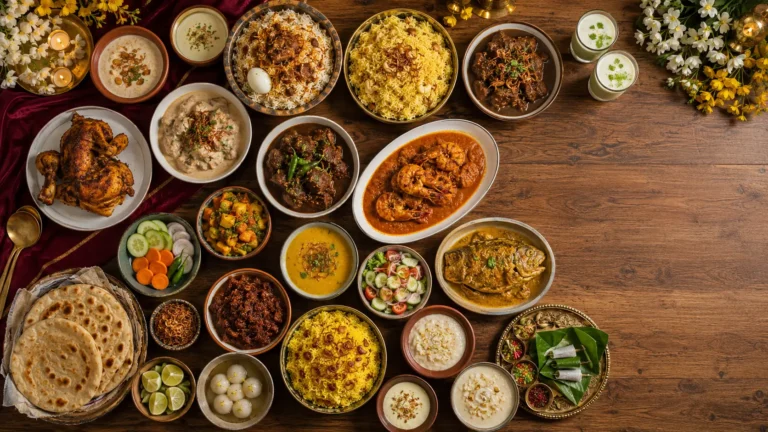
The dishes below aren’t tied to any one specific program. What a family chooses depends on budget, guest mix, caterer, and personal preference rather than a fixed rule for any particular event, so this is offered as a reference to browse and mix from, not a per-event menu plan. For a visual look at many of these dishes, see our Bangladeshi wedding food photo gallery.
Chicken: Chicken roast, murgh musallam, chicken rezala or korma, chicken bhuna or jhal fry, chicken tikka, jali/shami/tikiya kebab, tandoori chicken, reshmi kebab, seekh kebab, hariyali kebab, tangdi kebab, butter chicken, crumb-fried chicken, chicken shashlik, masala chicken, chicken chili-onion.
Beef and mutton: Beef bhuna or kala bhuna, mutton rezala, beef or mutton roast, beef kalia, kofta curry, mutton or beef shashlik, mutton or beef korma, beef chili-onion, whole roasted mutton or lamb (a head table upgrade).
Fish and seafood: Rui, katla, or ilish preparations (kalia, bhapa, fry), chingri malaikari, fish tikka, pomfret fry, bhetki fry, sweet and sour prawn, whole fish (a common head table upgrade).
Vegetarian and sides: Mixed vegetable curry, dal (masoor, moong, chana, or others), Dhakai paneer.
Rice and staples: Kacchi biryani, morog polao, basanti polao, kofta polao, keema polao, plain polao, biryani (chicken, mutton or beef), khichuri with lotpoti, tehari (a common lighter option, especially for Holud).
Desserts and sweets: Firni, mishti doi, rasmalai, jorda (sometimes with malai), shemai, traditional pitha, ice cream.
Drinks and accompaniments: Borhani, lemon or dahi sharbat (lassi), laban (also known as labang or labaan), soft drinks, juices, tea and coffee stations.
Live stations and add-ons: Kebab counters, fuchka and chaat, pasta or noodle counters, dessert counters.
Bangladeshi-style Chinese dishes: Common at Chinese restaurants and increasingly as an add-on elsewhere: wonton soup, chicken corn soup, thick Thai-style soup, chicken fried rice, fried chicken (desi or “cock” chicken versus broiler are often offered as separate choices), chicken chili-onion, beef chili-onion, sweet and sour prawn, beef sizzling, cashew nut salad.
A small but common detail: Beresta, crisp fried onions, appears across many of these dishes both as a flavor element and a plating garnish. It’s popular enough on its own that some guests specifically enjoy it separately from the dish it garnishes. Achar (pickles) and tok doi (sour curd) are also common accompaniments, often served on the side to cut through the richer meat and rice dishes.
Planning from Abroad: Notes for NRB Couples
Coordinating catering from outside Bangladesh adds a layer most local families don’t have to think about. A few things that consistently matter for NRB couples:
- Menu tastings. In-person tastings usually aren’t practical on a compressed visit. Ask whether the venue or caterer can do a video call tasting, or delegate tasting duty to a trusted relative or local planner.
- Single point of contact. Coordinating across a venue, a separate caterer, a decorator, and a hall on different time zones gets complicated fast. Formats that bundle food and venue together (hotel, resort) reduce the number of parties you need to sync with; formats that split them (community hall, baburchi, home) need a dedicated local coordinator.
- Compressed timelines. Many NRB families are only in Bangladesh for a short, fixed window. Formats that require more lead time for setup (baburchi cooking, outdoor tenting, home logistics) need earlier planning and confirmation than formats a venue handles start to finish.
- Dietary and guest-mix needs. If your guest list includes non-Bangladeshi or non-South Asian guests, flag spice level, vegetarian needs, and unfamiliar dishes early. Hotels and resorts are generally most practiced at adjusting for a mixed guest list; baburchi and home catering can accommodate this too, but it needs to be discussed directly rather than assumed.
- Written confirmation over verbal. Whatever format you choose, get menu, guest count, and setup details confirmed in writing (email, not just a phone call), since you may not be able to follow up in person if something is missed.
For the broader logistics of planning a wedding in Bangladesh from abroad, beyond catering specifically, see our guide to planning a wedding from the UK, USA, Europe, or Gulf.
Questions to Ask Your Caterer or Baburchi
A short checklist worth going through with any format:
- Is the menu built from a fixed package, or can individual dishes be substituted?
- What’s included in the price beyond food itself (serving staff, tableware, setup, cleanup)?
- Is on-site cooking allowed at this venue, or does food need to be prepared elsewhere and transported in?
- How is the final guest count confirmed, and what happens if it changes close to the event?
- Can dietary needs (vegetarian, low-spice, allergies) be accommodated, and does that need to be requested in advance?
- Is a tasting available, and can it be done remotely if you’re planning from abroad?
- What’s the contingency plan for weather, if the event is outdoor or partly outdoor?
- Is a head table or special-item upgrade available, and is it a separate request?
- What is the deadline for finalizing the menu and locking in the booking?
For a broader look at vendor vetting and avoiding inflated quotes across any category, not just catering, see our guide on hidden vendor markups NRB families should watch for.
Planning for Extra Food: Containers and Donation
In short: guest counts almost never match exactly, so planning for surplus food ahead of time, not on the day itself, avoids waste and creates an easy opportunity to give back.
With any format, ordered or prepared quantities are based on an estimated guest count, and actual attendance rarely lines up exactly. Families are often deep in wedding-day logistics and don’t think about what happens to extra food until it’s already sitting there, which usually means it either goes to waste or gets handled in a rush. A little planning before the event solves this.
Before the event:
- Decide in advance whether extra food will go home with family, be offered to guests to take away, or be donated, rather than deciding on the spot.
- Bring or arrange containers ahead of time. Guests and family members bringing their own boxes or containers to the venue makes taking food home simple, and many families now do this as a matter of course rather than an afterthought.
- If donation is part of the plan, identify ahead of time who will receive it. Some families have a standing relationship with a local mosque, shelter, or community group; others coordinate through the caterer or baburchi, who may already have a regular arrangement for surplus food.
- Confirm with the caterer or baburchi how surplus is normally handled on their end, since practice varies, and some may expect to take excess food themselves as part of their arrangement.
Why it’s worth planning ahead: Beyond simply avoiding waste, offering guests the option to take food home is a small, practical gesture of hospitality, and donating extra food to people in need turns a routine logistics decision into a meaningful part of the event itself.
Glossary of Terms
Baburchi — A traditional Bengali wedding cook or cooking team, typically hired directly by the family, independent of the venue.
Borhani — A spiced, savory yogurt drink commonly served alongside the main meal at Bangladeshi weddings.
Firni / Payesh — A rice pudding dessert, one of the most common closing sweets at Bangladeshi wedding meals.
Jorda / Zarda — A sweet, saffron-colored rice dish, often served as a dessert or alongside dessert.
Kacchi Biryani — A layered rice and meat dish, generally considered the signature centerpiece of a Bangladeshi wedding feast.
Polao — A fragrant rice dish, lighter than biryani, often used as the rice base for a wedding meal.
Rezala — A rich, yogurt-based curry, usually made with chicken, beef or mutton.
Bhuna — A slow-cooked, thick-gravy curry preparation, often made with beef.
Firani (the wedding program, not to be confused with Firni the dessert above) — The program held after Bou Bhaat/Walima/reception, practiced by many families.
Bou Bhaat / Walima — Different names for the same program: the reception hosted by the groom’s family after the wedding.
Aqd / Nikah — The Islamic marriage contract signing ceremony.
Gaye Holud — The turmeric ceremony, a traditional pre-wedding ritual for the bride and groom.
Sagarana (Shagorana) — An elaborately arranged platter presented to the groom at the head table, typically shared with his closest friends and family.
Beresta — Crisp fried onions, used widely as a garnish and flavor element across Bangladeshi wedding dishes.
Look N Feel – Event Solutions helps families plan and coordinate weddings across these formats. If you’d like support with a full-service event, including coordinating the food side, see our event management and wedding planning services, though we don’t own venues or provide catering ourselves. You can also take a look at our complete Bangladeshi and Bengali wedding food menu photo gallery with dish names for visual reference.